
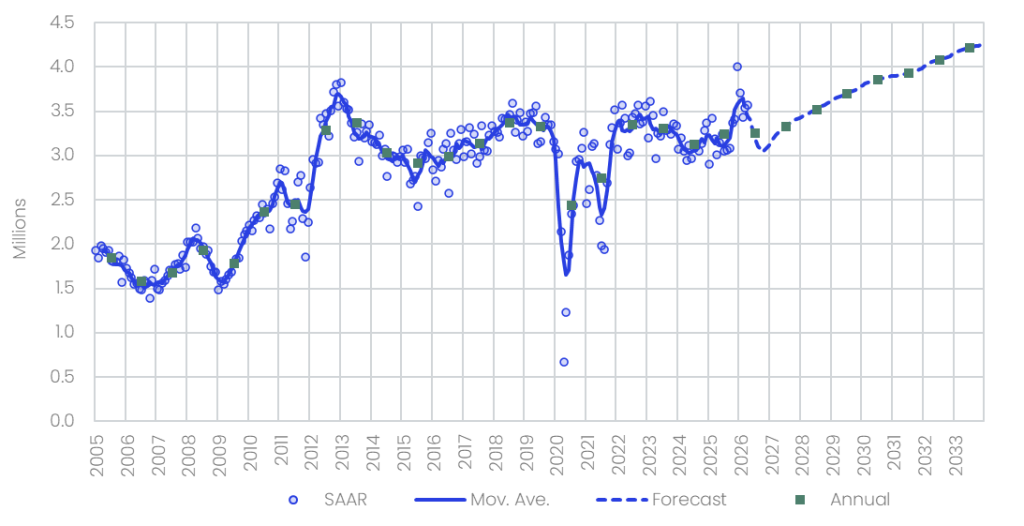
ASEAN Light Vehicle Market Posts Strong Start to 2026
The automotive industry across Southeast Asia has delivered a notably strong opening to 2026, with the ASEAN Light Vehicle (LV) market recording double-digit growth of 10% year-on-year (YoY) in the January–April period. Sales rose broadly across the region, driven by a combination of new model launches, government stimulus measures, and recovering consumer confidence in several key markets. However, the picture is far from uniform — diverging government policies and macroeconomic pressures are pushing individual country forecasts in sharply different directions, most notably Indonesia upward and Vietnam downward.
Indonesia: Government Policy and LCV Surge Power Sales Growth
Indonesia emerged as one of the standout performers in the region during the first four months of 2026. LV sales grew by 11% YoY, supported by positive momentum in both the Passenger Vehicle (PV) and Light Commercial Vehicle (LCV) segments. PV sales increased by a steady 3% YoY, underpinned by a wave of new model launches from both domestic and international automakers. More striking, however, was the performance of the LCV segment, which surged by an impressive 45% YoY — a figure that reflects both pent-up commercial demand and the influence of supportive government policy targeting the transportation and logistics sectors.
This strong performance has prompted upward revisions to Indonesia's full-year 2026 sales outlook. Analysts now anticipate that government-backed incentives and infrastructure investment programs will continue to stimulate commercial vehicle purchases throughout the remainder of the year. The LCV surge in particular signals that businesses are expanding fleet capacities in response to improving economic conditions and favorable fiscal policy. Indonesia's automotive market, already the largest in ASEAN, appears well-positioned to consolidate and build on its early gains in 2026.
Vietnam: Policy Headwinds Cloud the 2026 Outlook
In contrast, Vietnam's automotive sales outlook for 2026 has been revised downward, largely as a result of shifting government policy. After a period of strong growth supported by registration tax exemptions and other consumer incentives, the withdrawal or reduction of those measures has weighed heavily on buyer sentiment and purchasing activity. The Vietnamese government's decision to scale back some of the temporary tax relief that had previously buoyed the market is now expected to translate into a meaningful decline in full-year sales volumes.
The policy reversal has created a challenging environment for automakers operating in Vietnam, many of whom had ramped up inventory and planned product launches around a continued incentive framework. With consumers now facing higher vehicle ownership costs, demand is expected to soften — particularly in the mass-market PV segment, which had been the primary beneficiary of the earlier tax breaks. The revised 2026 outlook for Vietnam underscores how sensitive automotive demand in emerging markets can be to government intervention, and how quickly the tide can turn when those supports are removed.
Philippines: Ongoing Decline Driven by Energy Prices and GDP Risk
The Philippines was the only ASEAN market to report an outright decline in LV sales during the January–April 2026 period, posting a drop of 24% YoY. Sales fell every single month: -3% YoY in January, -2% in February, -7% in March, and -12% in April. The accelerating pace of decline through the first quarter and into April raises concerns about underlying demand conditions in the market.
The primary culprit behind the weakness in March and April was rising energy prices, driven by the ongoing conflict in the Middle East. Higher fuel costs reduced disposable income and increased the total cost of vehicle ownership, dampening consumer appetite for new cars and light trucks. While analysts note that the April result aligned broadly with prior projections — keeping the full-year sales outlook largely unchanged — the forecast still points to a meaningful contraction. LV sales in the Philippines are anticipated to fall from 489,000 units in 2025 to approximately 463,000 units in 2026.
Beyond energy prices, a recently downgraded GDP growth forecast for the Philippines introduces additional near-term risk to the sales outlook. If economic growth underperforms, consumers are likely to delay major purchases such as vehicles, which could push actual sales figures below current projections. The market faces a difficult balancing act between structural long-term demand potential and short-term macroeconomic headwinds.
Broader ASEAN Trends: A Market Shaped by Policy and Macro Forces
The mixed performance across ASEAN's automotive markets in early 2026 reflects a broader truth about the region: government policy and macroeconomic conditions remain the dominant forces shaping demand. Where governments have actively supported the market through incentives, infrastructure spending, or favorable regulatory environments — as in Indonesia — sales have responded positively. Where policy has become less supportive — as in Vietnam — demand has softened. And where external macroeconomic shocks such as energy price inflation have taken hold — as in the Philippines — consumers have pulled back.
- Indonesia benefits from strong LCV demand and supportive government fiscal policy, driving an upward revision to its 2026 sales forecast.
- Vietnam faces a downward revision following the withdrawal of registration tax exemptions and related consumer incentives.
- The Philippines continues to struggle with energy price-driven demand weakness and a deteriorating GDP growth outlook.
- The broader ASEAN market remains on a positive trajectory, with 10% YoY growth in the first four months suggesting underlying resilience across the region.
What to Watch for the Rest of 2026
As the year progresses, several factors will determine whether ASEAN's automotive sector can sustain its early momentum. In Indonesia, the durability of government spending commitments and the continued rollout of new vehicle models will be critical. In Vietnam, any policy reversal or reintroduction of tax incentives could provide an unexpected boost to demand. In the Philippines, the trajectory of global energy prices and the domestic GDP growth rate will be closely watched by industry participants and analysts alike.
For automakers and investors with exposure to Southeast Asia, the 2026 ASEAN light vehicle market offers both significant opportunity and meaningful risk. The region's long-term growth story remains intact — rising middle-class populations, urbanization, and underpenetrated vehicle ownership rates all point to sustained demand over the coming decade. But navigating the near-term volatility requires a clear-eyed understanding of each market's individual policy environment and macroeconomic backdrop. The divergence between Indonesia and Vietnam in 2026 is a timely reminder that in ASEAN automotive, not all markets move in the same direction at the same time.