
The Ford Model T: A Revolutionary Car With a Surprisingly Complex Transmission
When most people picture the Ford Model T, they imagine a rattling, boxy automobile chugging down a dusty dirt road — something charmingly primitive, almost toy-like by modern standards. And in many respects, that impression is not entirely wrong. The Model T was deliberately designed to be affordable, reliable, and easy to maintain, qualities that made it the car that put America on wheels. But there is one glaring exception to its reputation for simplicity: the transmission. Beneath its unassuming hood lurked a gearbox that could humble experienced drivers and baffle first-timers well into the 1920s.
How the Ford Model T Changed Automotive History
Introduced in 1908, the Ford Model T was the brainchild of Henry Ford and his engineering team. Ford's goal was audacious for its time — to build a motorcar that the average American worker could actually afford to buy. Prior to the Model T, automobiles were luxury items reserved for the wealthy. Ford changed that equation forever, not just by engineering a capable vehicle, but by pioneering the moving assembly line at his Highland Park plant, which allowed him to produce cars at a scale and cost no one had ever achieved before.
By the time production ended in 1927, more than 15 million Model Ts had rolled off the assembly line, a production record that stood for decades. The car is rightly credited with reshaping American infrastructure, fueling demand for paved roads, spurring the growth of the auto industry, and fundamentally transforming how people lived, worked, and traveled. Few machines in human history can claim such sweeping cultural impact.
Yet for all its historical greatness, the Model T asked something unusual of its drivers: it demanded that they learn an entirely different kind of driving logic, one centered on its unconventional planetary transmission.
What Made the Model T's Transmission So Different?
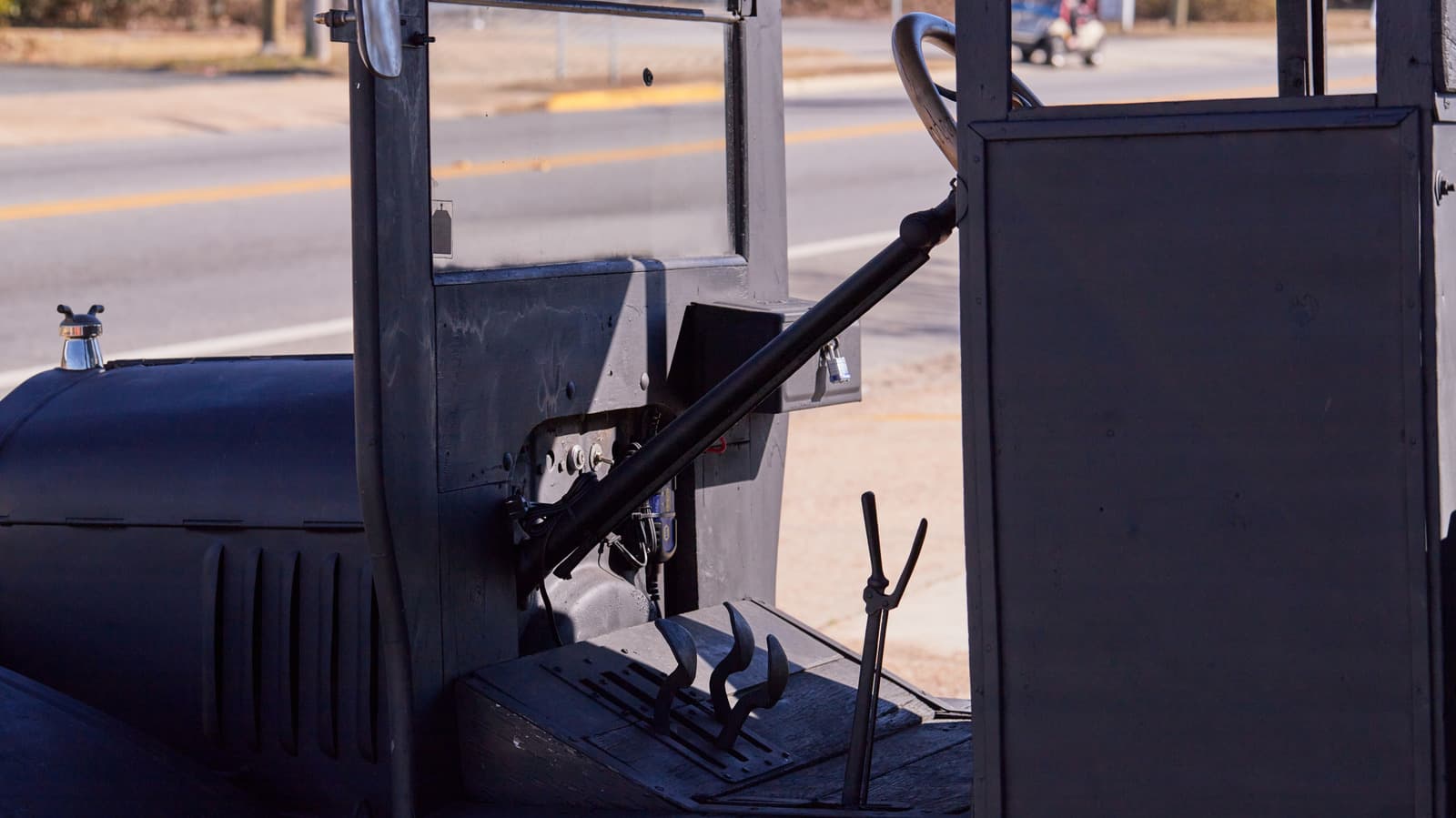
The Ford Model T did not use a conventional sliding-gear transmission like those found in most contemporary and modern vehicles. Instead, it relied on a two-speed planetary transmission — a design that was actually considered modern and even sophisticated at the time of the car's introduction, but which operated through a system of foot pedals and hand levers that bore almost no resemblance to what drivers today would recognize.
Here is how the system worked in practice:
- Three pedals on the floor controlled forward speeds and reverse, but none of them were a clutch in the conventional sense. The left pedal cycled between low gear, neutral, and high gear depending on how far it was pressed. The center pedal engaged reverse. The right pedal was the brake.
- A hand lever on the left side, known as the emergency brake lever, also played a role in gear selection. When pulled all the way back, it locked the transmission in neutral and engaged the parking brake. When pushed forward, it allowed the foot pedal to cycle through the gears normally.
- The throttle was not a foot pedal at all — it was a hand lever mounted on the steering column, along with the spark advance control.
Getting underway in a Model T required coordinating all of these inputs simultaneously, and doing it smoothly enough not to stall the engine or lurch violently into traffic. It was a skill that took real practice to develop.
Why Learning to Drive a Model T Was a Real Challenge
New drivers approaching the Model T for the first time often found the experience deeply counterintuitive. The instinct to look for a standard clutch pedal was immediately frustrated. Pressing the left pedal all the way down put the car in low gear — releasing it partway slipped it into neutral, and releasing it fully engaged high gear, provided the hand lever was in the correct position. Miscalculate, and the car would jerk, stall, or leap forward in ways that startled both driver and bystanders.
Reverse added another layer of confusion. The center pedal engaged reverse, but only when the hand lever was in a specific position and the engine was running at the right speed. Mistime it, and you could find yourself rolling in an entirely unintended direction.
Stopping the car also required relearning instincts. Drivers had to simultaneously manage the hand throttle on the column, coordinate their foot pedals, and remember that the right foot pedal operated a transmission brake rather than wheel brakes. It was, in every sense, a full-body cognitive exercise.
The Planetary Transmission: Innovative for Its Era
It is worth noting that Henry Ford did not choose the planetary transmission because he wanted to torture drivers. At the time, it was genuinely regarded as an improvement over the conventional crash gearboxes of the era, which required drivers to carefully match engine speeds and physically force gear clusters into engagement — a process so noisy and difficult that it earned the evocative nickname "the crash box." The planetary system, by contrast, allowed for smoother, band-controlled engagement and required less raw mechanical force to operate.
The two-speed planetary system also suited the Model T's intended market. Ford expected that many of his buyers would be rural farmers with little or no prior driving experience. A planetary transmission, once learned, was more forgiving of missed shifts than a conventional manual gearbox, and its robust simplicity meant fewer trips to the mechanic.
A Legacy That Outlasted the Car Itself
The planetary transmission concept that Ford used in the Model T did not disappear when the car was retired in 1927. Planetary gear sets went on to become the foundation of virtually every modern automatic transmission. The smooth, band-actuated engagement logic that Model T drivers wrestled with using foot pedals and hand levers has been refined over nearly a century into the seamless automatic gearboxes found in the vast majority of cars on the road today.
So while the Ford Model T's transmission felt like a puzzle to those who encountered it for the first time, it represented a genuine engineering philosophy that proved remarkably durable. The car that put the world on wheels also quietly planted the seeds of the transmission technology that would eventually make driving simple for everyone.
Conclusion: Simple on the Outside, Complex at Heart
The Ford Model T is one of those machines that rewards closer inspection. Its reputation for rugged simplicity is well earned in many areas — the engine is straightforward, the chassis is robust, and the mechanics are generally accessible to anyone with basic tools. But the transmission tells a different story, one of ingenious engineering wrapped in a deeply unfamiliar interface. For modern drivers accustomed to automatics or even conventional manuals, sitting behind the wheel of a Model T for the first time is a genuine lesson in how much driving knowledge we take for granted. The car that changed history did so, in part, by asking its drivers to change the way they thought about operating a machine — and that, perhaps, is the most enduring lesson the Model T has to offer.