
Behind the Scenes: How EV Charging Equipment Is Actually Made
Most electric vehicle owners plug in their cars every night without giving much thought to the device doing the work. That small, precisely engineered box sitting on the garage wall — or the adapter tucked neatly in the glove compartment — is the product of a sophisticated, multi-stage manufacturing process. To understand exactly how EV charging equipment goes from raw materials to finished product, we toured the Chinese facility where Lectron assembles its charging adapters and its new Nexus Level 2 home-charging unit. What we found was equal parts high-tech precision and meticulous human craftsmanship.
Why China Remains Central to EV Charging Manufacturing
It is no secret that a significant portion of the world's consumer electronics and EV hardware is manufactured in China. The country has spent decades building an unmatched ecosystem of component suppliers, skilled assembly workers, and quality-control infrastructure. For EV charging specifically, China's dominance is even more pronounced, given its position as the world's largest electric vehicle market. Manufacturers like Lectron leverage this ecosystem to keep costs competitive while maintaining the production scale needed to meet rapidly growing global demand.
Lectron, a brand that has gained strong recognition among North American EV owners for its affordable and compatible charging solutions, chose to base its assembly operations in China precisely because of this ecosystem. The facility we visited is not a cavernous, anonymous warehouse — it is a carefully organized production environment where engineers, quality inspectors, and assembly technicians work together under one roof.
Walking the Production Floor: What the Assembly Process Looks Like
From the moment you step onto the production floor, it is clear that EV charging equipment manufacturing demands far more precision than most people would expect. The process begins well before a single adapter or charger takes its recognizable shape.
Component Sourcing and Incoming Inspection
Every production run starts with incoming quality control. Raw components — circuit boards, copper contacts, plastic housings, thermal management materials, and wiring harnesses — arrive from a network of vetted suppliers. Before any component reaches the assembly line, it goes through an inspection process to verify that it meets dimensional, electrical, and material specifications. Rejected components are quarantined and returned, ensuring that nothing substandard enters the build process.
PCB Assembly and Soldering
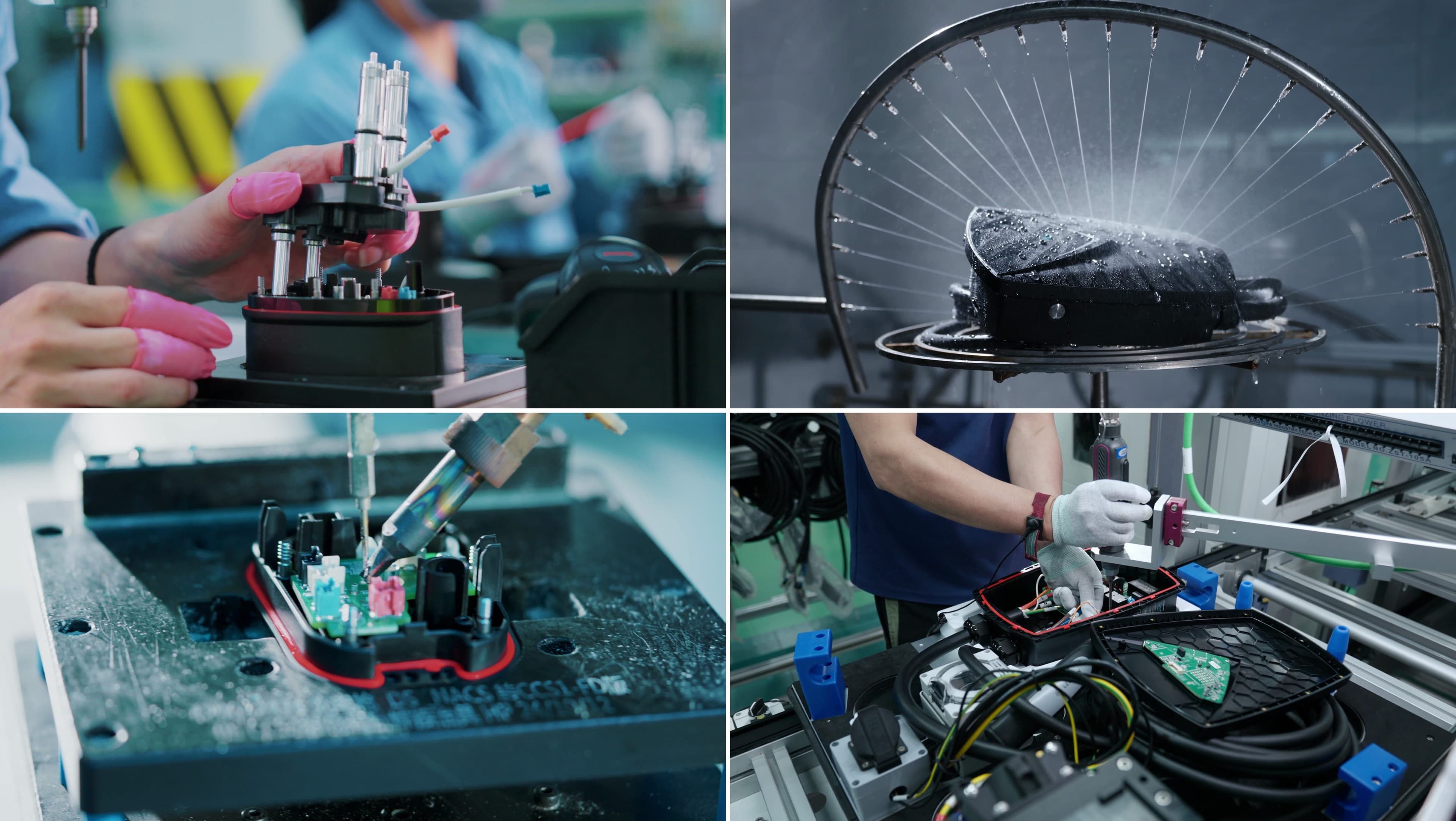
The brain of any EV charger or adapter is its printed circuit board. At the Lectron facility, PCBs are populated with surface-mount components using automated pick-and-place machines, then passed through a reflow oven to create reliable solder joints. More complex or delicate connections are handled by trained technicians performing hand soldering under magnification. After soldering, each board undergoes automated optical inspection to catch defects that the naked eye might miss.
Mechanical Assembly and Housing
Once the electronics are ready, the mechanical assembly begins. For the Nexus Level 2 home-charging unit, this means carefully integrating the power electronics into a weather-resistant enclosure engineered for both indoor and outdoor installation. For the charging adapters, it means precisely fitting copper contact pins, locking mechanisms, and protective overmolding. Every fastener is torqued to specification, and every seam is checked for the kind of fit and finish that protects sensitive components from moisture, dust, and the daily mechanical stress of repeated plugging and unplugging.
The Lectron Nexus Level 2 Home Charger: What Makes It Different
The Nexus Level 2 charger represents Lectron's push into the premium home-charging segment. Unlike basic Level 1 charging that relies on a standard household outlet, Level 2 equipment operates on 240-volt circuits and can deliver a full overnight charge far more efficiently. Watching the Nexus units come together on the assembly line, it becomes clear that the design prioritizes both performance and user-friendly installation. The unit is built to work with a wide range of electric vehicles, reflecting Lectron's longstanding commitment to broad compatibility.
Quality Testing: The Step That Cannot Be Skipped
No charging unit or adapter leaves the Lectron facility without passing a battery of electrical and safety tests. Finished units are connected to test rigs that simulate real-world charging loads, checking for correct voltage output, stable current delivery, proper ground fault detection, and thermal behavior under sustained operation. Adapters are tested for contact resistance and mechanical durability. Any unit that fails is pulled from the line, diagnosed, and either reworked or scrapped — there is no cutting corners on a product that interfaces directly with a vehicle's battery system.
- High-voltage dielectric strength testing to verify insulation integrity
- Ground continuity checks across all conductive paths
- Thermal imaging to identify unexpected hotspots during load testing
- Mechanical cycle testing on connectors and locking mechanisms
- Final functional verification on a live charging circuit before packaging
What Factory Tours Reveal About the EV Charging Industry
Touring a facility like Lectron's does something that product listings and marketing materials cannot: it builds genuine confidence in the hardware. Seeing the inspection stations, the test rigs, and the attentive technicians makes it easier to understand why quality EV charging equipment — even when manufactured overseas — can be a reliable, safe, and long-lasting part of your home charging setup.
It also underscores a broader truth about the EV industry: the transition to electric transportation is not just happening on the road. It is happening in factories around the world where engineers are quietly solving the unglamorous but essential problem of how to move electricity from the wall to the battery, safely, efficiently, and millions of times over.
Final Thoughts: Should You Trust EV Charging Equipment Made in China?
The honest answer, after a floor-level look at how Lectron builds its products, is that country of origin matters far less than the rigor of the quality systems behind the product. What matters is whether a manufacturer invests in real testing infrastructure, trained personnel, and genuine quality control — and based on what we observed, Lectron does exactly that. As demand for home EV charging continues to surge alongside rising electric vehicle adoption, facilities like this one will only grow in importance, supplying the hardware that keeps millions of EVs charged and ready to drive.