
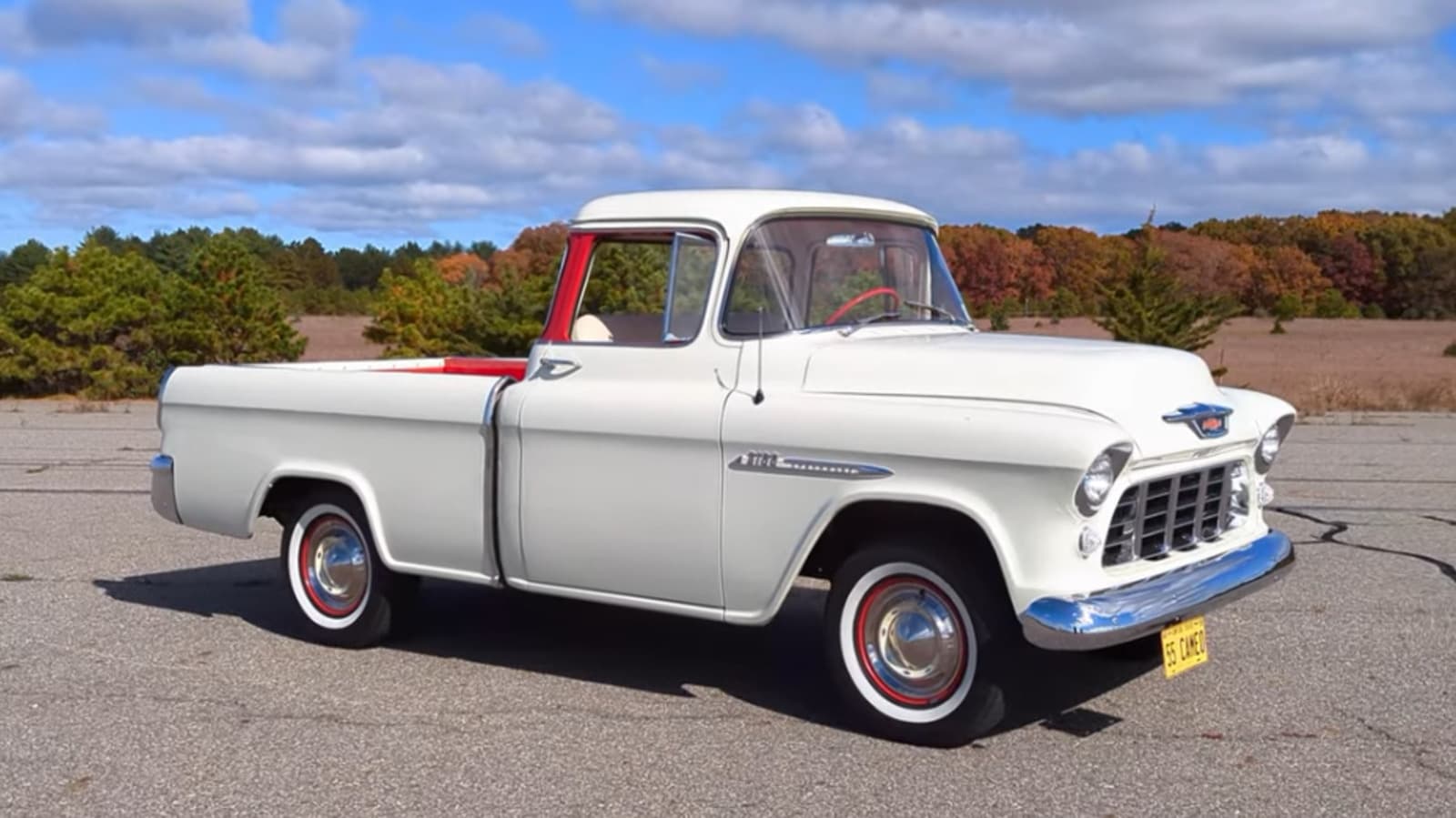
The Truck That Changed Everything: Meet the 1955 Chevy Cameo Carrier
Today, pickup trucks are among the best-selling vehicles in America. They haul families to soccer games, park outside steakhouses, and come loaded with leather seats, touchscreen infotainment systems, and more chrome than a 1950s diner. But it wasn't always this way. For most of automotive history, a pickup truck was a tool — a muddy, loud, no-frills machine built for hauling feed, lumber, and livestock. The transformation from workhorse to lifestyle statement didn't happen overnight, and it didn't happen by accident. It happened because of one remarkable vehicle: the 1955 Chevrolet Cameo Carrier.
What Was the 1955 Chevy Cameo Carrier?
The Cameo Carrier was a limited-production, stylized pickup truck introduced by Chevrolet as part of its second-generation Task Force truck lineup. While it shared its cab and chassis with the standard Chevy 3100 half-ton pickup, almost everything else about the Cameo was designed to stand apart from the crowd. Rather than the utilitarian box bed found on working trucks of the era, the Cameo featured a fiberglass outer bed with smooth, flush panels that mimicked the flowing lines of contemporary Chevrolet passenger cars.
The name itself was carefully chosen. "Cameo" evoked elegance, artistry, and femininity — qualities no one had ever associated with a pickup truck before 1955. Chevrolet wasn't just selling a truck; it was selling an image, a lifestyle, and a new way of thinking about what a pickup could be.
Design Details That Made the Cameo Carrier Revolutionary
The visual centerpiece of the Cameo Carrier was its proprietary fiberglass cargo bed. Standard pickups of the mid-1950s had exposed, angular metal beds with visible stake pockets and wheel wells that protruded awkwardly into the cargo area. The Cameo smoothed all of that away. The outer bed walls were seamless and sculpted, flowing elegantly from the cab to the tailgate in a way that looked more like a two-tone sedan than a work truck.
The tailgate was another marvel of industrial design. Instead of a bare stamped-metal panel, the Cameo's tailgate was integrated into the smooth bed design and featured a clean, stylish appearance that complemented the overall silhouette. Even the rear bumper was painted body color, a detail almost unheard of in the pickup segment at the time.
Inside, the Cameo offered a level of interior refinement that left its competitors scratching their heads. Buyers could opt for full carpeting, a two-tone color scheme inside the cab, chrome trim details, and a level of fit and finish that rivaled the family car sitting in the same driveway. The truck was available in Bombay Ivory with red accents as its signature color combination, though other options were offered over its production run.
Performance and Powertrain
The Cameo Carrier wasn't just about looks. Under the hood sat Chevrolet's newly introduced 265 cubic-inch small-block V8 engine, one of the most significant powerplants in American automotive history. This engine, which debuted across the Chevrolet lineup in 1955, produced around 162 horsepower in standard tune — a healthy figure for a half-ton pickup of the era. Paired with either a three-speed manual transmission or an available Hydra-Matic automatic, the Cameo offered a driving experience that was considerably more car-like than anything else in the segment.
The ride quality benefited from the same improvements Chevrolet made across its entire 1955 truck lineup, including a new front suspension setup that delivered greater comfort and road manners. For buyers who were accustomed to the harsh, bouncing ride of a traditional work truck, climbing into a Cameo felt like a revelation.
Sales, Production Numbers, and Market Reception
The Cameo Carrier was never intended to be a high-volume seller. Chevrolet produced approximately 5,220 units for the 1955 model year, with production continuing through 1958 before the model was discontinued. Numbers varied year to year, and the truck always carried a significant price premium over a standard Chevy pickup — which naturally limited its audience to buyers who genuinely wanted something special.
Reception was mixed in the short term. Some traditional truck buyers found the whole concept puzzling, even unnecessary. Why pay extra for smooth bed panels and carpeting on a vehicle meant for work? But others — suburban homeowners, small business owners, style-conscious buyers — immediately understood what Chevrolet was offering. The Cameo proved that a meaningful market existed for trucks that prioritized comfort, style, and personal expression alongside functionality.
The Cameo Carrier's Lasting Legacy
It's impossible to look at the modern pickup truck landscape without seeing the Cameo Carrier's fingerprints everywhere. The Ford F-150 Platinum, the Ram 1500 Longhorn, the Chevy Silverado High Country — these are all descendants of the philosophy that Chevrolet first articulated in 1955. The idea that a truck could be luxurious, stylish, and aspirational without sacrificing its fundamental identity as a pickup is the very premise on which the modern truck market is built.
The Cameo also directly influenced the Fleetside bed design that Chevrolet introduced across its standard trucks in 1958, featuring those same flush, smooth outer bed walls that the Cameo had pioneered in fiberglass. From that point forward, the styling DNA of the lifestyle pickup was baked into mainstream truck production for good.
Why the 1955 Chevy Cameo Carrier Still Matters Today
Collectors and automotive historians regard the Cameo Carrier with well-deserved reverence. Surviving examples command strong prices at auction, and well-restored models are showstoppers at any classic truck gathering. Beyond collector value, though, the Cameo matters because it represents a genuinely transformative moment in American automotive culture.
Before 1955, the pickup truck knew its place. After the Cameo Carrier, nothing was ever quite the same. Chevrolet had the audacity to reimagine what a truck could mean to its owner — and in doing so, it planted the seed for an entire segment that now dominates the American automotive market. The next time you see a fully loaded Ram or a leather-trimmed F-150 rolling through a city that has never seen a day of farm work, remember the elegant little Chevy that started it all.