
How the 1955 Chevy Cameo Carrier Invented the Lifestyle Pickup Truck
Today, pickup trucks are among the best-selling vehicles in America. Buyers choose them not just for hauling lumber or towing trailers, but for school runs, weekend road trips, and making a statement in a crowded parking lot. The modern pickup truck is as much a lifestyle accessory as it is a utility vehicle. But this transformation didn't happen overnight — and it didn't happen by accident. You can trace the birth of the lifestyle pickup to one specific model year, one specific manufacturer, and one remarkably bold design decision: the 1955 Chevrolet Cameo Carrier.
What Was the Chevy Cameo Carrier?
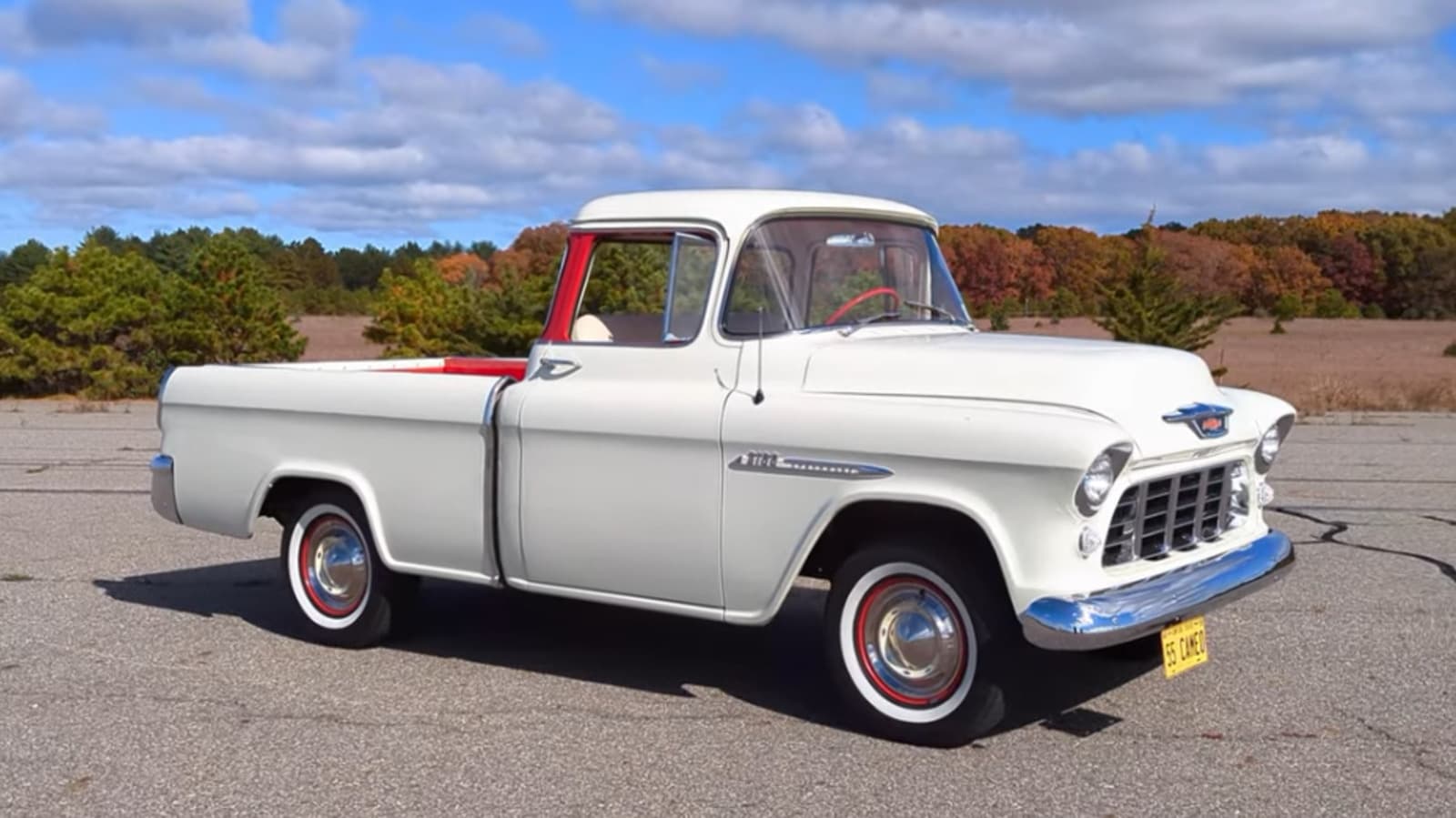
The Cameo Carrier was a special variant of Chevrolet's Task Force pickup truck line, introduced for the 1955 model year. On the surface, it was a half-ton truck. But in practice, it was something far more radical for its time. While every other pickup on the market wore its utilitarian roots on its sleeve — exposed rear fenders, squared-off beds, and no-frills interiors — the Cameo Carrier dared to look like it belonged in a showroom alongside Chevrolet's passenger cars.
The most immediately striking feature was the truck's rear end. Chevrolet's designers crafted smooth, flush fiberglass panels that completely covered the traditional step-side fenders that defined pickup trucks of the era. The result was a wide, seamless, car-like body that flowed uninterrupted from cab to tailgate. Nobody had ever seen anything like it on a truck. It looked expensive, sophisticated, and surprisingly elegant.
The Design Philosophy That Changed Everything
The man most credited with the Cameo Carrier's revolutionary appearance was Chuck Jordan, a young Chevrolet designer who would later rise to become General Motors' Vice President of Design. Jordan's vision was simple but audacious: what if a pickup truck could look as good as a sports car? What if a working man's vehicle could also be something a suburban professional was proud to park in the driveway?
To achieve this, the Cameo received a number of passenger car-inspired touches that were virtually unheard of in the truck segment at the time. The interior was upgraded with a two-tone color scheme, comfortable seating, and chrome accents. The exterior came finished in Bombay Ivory as standard, with contrasting trim panels along the lower body. Chrome bumpers, a clean hood line, and whitewall tires completed the picture. This was a truck dressed up like it was going somewhere important — and that was entirely the point.
Performance and Specs That Backed Up the Style
The Cameo Carrier wasn't just a pretty face. Under the hood, buyers could spec the truck with Chevrolet's new 265 cubic-inch V8 engine, part of the legendary small-block family that would power GM vehicles for decades to come. This gave the Cameo genuine performance credentials to match its good looks. Available with either a three-speed manual or an optional Hydra-Matic automatic transmission, the truck was genuinely pleasant to drive — another characteristic that set it apart from the punishing ride quality most trucks delivered at the time.
Despite being built on a standard half-ton platform, the Cameo was priced significantly above typical pickups of its day, positioning it as a premium product aimed squarely at a new kind of buyer: someone who needed occasional truck capability but refused to sacrifice style or comfort to get it.
A Short Production Run With a Long Legacy
Chevrolet produced the Cameo Carrier from 1955 through 1958, a relatively brief four-year run. Production numbers were always modest — fewer than 5,000 units were sold in 1955 alone, and totals remained comparatively low throughout its lifespan. The Cameo was retired when Chevrolet introduced the flush-sided Fleetside bed as a standard option across its truck lineup in 1958, making the Cameo's most distinctive feature available to every buyer at a lower price point.
In purely commercial terms, the Cameo Carrier was never a blockbuster. But its influence on the American automotive industry proved immeasurable. By proving that truck buyers would pay more for style, comfort, and prestige, the Cameo opened a door that has never been closed.
The Lifestyle Truck Revolution It Sparked
Every premium pickup truck on the road today owes a debt to the Cameo Carrier. Consider the vehicles that dominate today's truck market:
- The Ford F-150 Platinum and Limited trims offer heated and ventilated massaging seats, panoramic moonroofs, and interior materials that rival luxury sedans.
- The Ram 1500 Laramie Longhorn features hand-stitched leather, real wood trim, and multi-zone climate control.
- The GMC Sierra Denali competes directly with high-end European SUVs on interior refinement and technology.
These trucks exist because, in 1955, Chevrolet proved the market for them existed. The Cameo Carrier was the proof of concept that told the entire industry: truck buyers don't just want function — they want to feel good about their vehicle.
Why the 1955 Cameo Carrier Still Matters Today
For collectors and automotive historians, the 1955 Chevy Cameo Carrier holds a place of genuine reverence. Surviving examples in good condition command strong prices at auction, valued both for their rarity and for their historical significance. Driving one today is a vivid reminder of just how bold the original concept was — a truck that didn't apologize for wanting to be beautiful.
In an era when pickups were strictly tools, Chevrolet had the imagination to ask a different question: why can't a truck be something more? The Cameo Carrier answered that question with chrome, fiberglass, and a confidence that still feels modern nearly seventy years later. Every lifestyle pickup truck built since — every luxury trim package, every sculpted body line, every wood-and-leather interior — traces its lineage directly back to that radical 1955 design. The Cameo Carrier didn't just invent the lifestyle pickup truck. It invented the idea that driving a truck could be something to aspire to.