
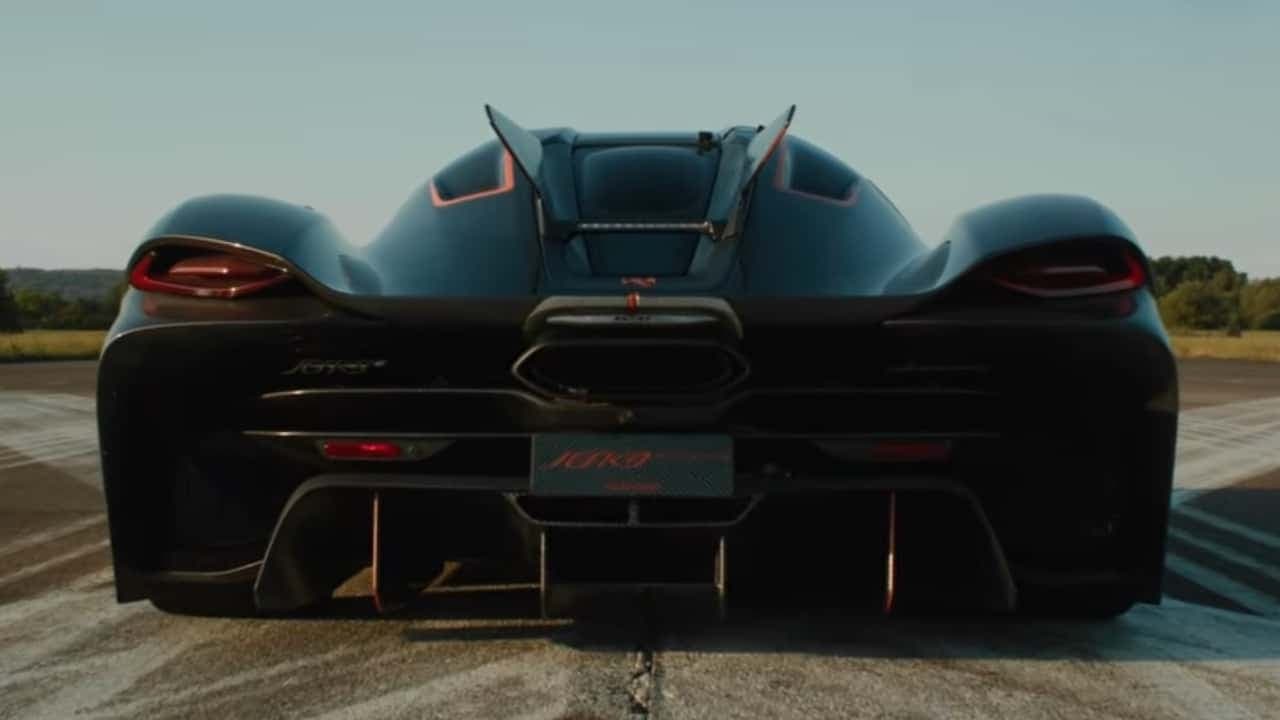
Koenigsegg Jesko Absolut Smashes the Quarter-Mile Speed Record for Production Cars
In the world of hypercars, records are broken with increasing regularity — but few milestones capture the imagination quite like the quarter-mile run. It is one of motorsport's oldest and most celebrated benchmarks, a straight-line test of raw power, engineering precision, and sheer mechanical audacity. The Koenigsegg Jesko Absolut has now redefined what is possible, blazing through the quarter mile at a staggering 190 mph and setting a new production car record in the process. Oh, and the driver was holding a phone in one hand while doing it.
What Is the Koenigsegg Jesko Absolut?
Before diving into the record itself, it helps to understand exactly what the Jesko Absolut is and why it was always destined to make history. The Jesko Absolut is the top-speed-focused variant of the Koenigsegg Jesko, a hypercar named in honor of Jesko von Koenigsegg, the father of company founder Christian von Koenigsegg. While the standard Jesko is built with track performance in mind, the Absolut variant was engineered from the ground up with one singular obsession: maximum velocity.
Koenigsegg has stated that the Jesko Absolut is theoretically capable of exceeding 330 mph, which would make it the fastest road car ever built if that figure is ever officially validated on a closed course. The car is powered by a 5.0-liter twin-turbocharged V8 engine producing an almost incomprehensible 1,600 horsepower on E85 biofuel. That power is routed through Koenigsegg's revolutionary Light Speed Transmission (LST), a nine-speed multi-clutch gearbox capable of shifting between any gear almost instantaneously.
Every element of the Jesko Absolut's design prioritizes aerodynamic efficiency. Compared to the standard Jesko, it produces significantly less downforce, which reduces drag and allows the car to slice through the air at extreme speeds. The bodywork is sculpted, the underbody is carefully managed for airflow, and even the tiniest details — from the door handles to the wing geometry — serve the singular purpose of going faster than anything else on four wheels.
The Quarter-Mile Record Run
The quarter-mile, or 400-meter drag strip, has long been the proving ground for the world's most powerful machines. Until recently, the standing production car record for trap speed at the quarter-mile mark was held by a select handful of elite machines. The Jesko Absolut obliterated that benchmark by registering 190 mph at the finish line — a figure that would have seemed absurd just a decade ago for a street-legal vehicle.
What makes the run even more extraordinary is the detail that has since captured the attention of the automotive world: the driver was holding a phone with one hand during the pass. Whether this was for documentation, communication, or simply a statement of supreme confidence in the car's capabilities, the image speaks volumes. At 190 mph, a single lapse in focus or control could be catastrophic. The fact that the driver felt comfortable enough to manage the run one-handed is a testament both to their skill and to the Jesko Absolut's remarkable stability and composure at speed.
This is not simply a stunt. It reflects the engineering philosophy at the heart of Koenigsegg's work — building cars that are not just fast, but genuinely drivable and controllable at the limits of performance. The LST gearbox, the active aerodynamics, and the finely tuned chassis all work in concert to give the driver confidence even when the numbers on the speedometer climb to territory most people will never experience.
How Does 190 MPH at the Quarter Mile Compare?
To put 190 mph in context, consider that many performance-oriented sports cars struggle to crack 120 mph at the quarter-mile mark. Even elite supercars from brands like Ferrari, Lamborghini, and Porsche typically post trap speeds in the 130 to 150 mph range for their most powerful models. The gap between 150 mph and 190 mph may seem numerically modest, but in terms of kinetic energy and the physical demands placed on the car and driver, it represents an entirely different league of performance.
The Bugatti Chiron Super Sport 300+, one of the Jesko Absolut's most cited rivals in the extreme speed conversation, is a formidable machine in its own right. Yet the Jesko Absolut's quarter-mile trap speed underscores just how focused and effective the Swedish manufacturer's engineering approach truly is.
Why Koenigsegg Continues to Push Boundaries
Founded in 1994 by Christian von Koenigsegg in a small town in southern Sweden, the company has always operated with the mindset of a challenger. It does not have the century-long heritage of Ferrari or the corporate resources of Volkswagen Group. What it has instead is an obsessive commitment to innovation, a willingness to develop proprietary technology in-house, and a culture that refuses to accept existing limits as permanent.
From inventing its own transmission to developing its own carbon fiber manufacturing processes, Koenigsegg approaches each new model as an opportunity to solve problems the rest of the industry has not yet addressed. The Jesko Absolut is the fullest expression of that philosophy to date.
What This Record Means for the Future of Hypercars
Records like this matter beyond bragging rights. They push the entire automotive industry forward, inspiring engineers at every level to rethink assumptions about what is mechanically possible. When a production car can legitimately hit 190 mph at the quarter-mile, it forces tire manufacturers, fuel developers, transmission engineers, and aerodynamicists to evolve.
For enthusiasts, the Jesko Absolut's record run is a reminder of why hypercars exist in the first place — not as practical transportation, but as rolling laboratories of human ingenuity. They are proof that the ceiling of performance has not yet been reached, and that somewhere in a workshop in Ängelholm, Sweden, a small team of engineers is already thinking about what comes next.
The quarter-mile will never look quite the same after 190 mph. And somehow, impossibly, the driver had a hand to spare.