
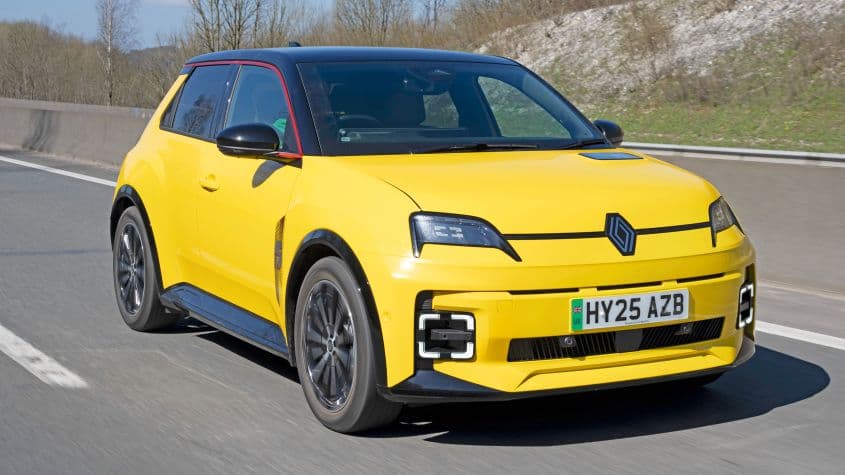
Renault 5 and Renault 4 Could Soon Become Even More Affordable
Electric vehicles have long been criticised for sitting out of reach for the average family driver. Price tags that stretch well beyond what many households can comfortably afford have slowed EV adoption across Europe, despite growing demand for cleaner, greener transport. Renault, however, has been making bold strides in the right direction — and now, the French automaker appears ready to take another significant step toward true mass-market electrification.
According to recent reports, both the Renault 5 and the Renault 4 could benefit from the same LFP (lithium iron phosphate) battery technology being introduced in the upcoming Renault Twingo. If realised, this move would make two of Renault's most beloved electric nameplates even more accessible to everyday buyers, potentially reshaping the affordable EV landscape in Europe and beyond.
What Is LFP Battery Technology and Why Does It Matter?
To understand why this development is so significant, it helps to first understand what LFP batteries are and how they differ from the lithium-ion NMC (nickel manganese cobalt) packs that currently power most mainstream electric cars.
LFP, or lithium iron phosphate, is a type of battery chemistry that has gained enormous popularity in recent years — largely thanks to its adoption by manufacturers like BYD and Tesla in their entry-level models. The technology offers several compelling advantages over traditional NMC batteries:
- Lower production cost: LFP batteries do not rely on expensive materials like cobalt or nickel, making them significantly cheaper to manufacture at scale.
- Improved safety: LFP chemistry is inherently more thermally stable, reducing the risk of overheating and fires.
- Longer cycle life: These batteries tend to degrade more slowly over time, meaning they retain usable capacity through more charge-discharge cycles.
- Better tolerance for full charges: Unlike NMC packs, LFP batteries can regularly be charged to 100% without significantly accelerating degradation.
The trade-off, traditionally, has been a lower energy density — meaning a larger, heavier battery pack is needed to achieve the same range as an NMC equivalent. However, as manufacturing techniques improve, this gap is narrowing rapidly. For city-focused or short-range vehicles, LFP is increasingly the smarter, more economical choice.
The Renault Twingo: A Blueprint for Budget-Friendly EVs
The new Renault Twingo is set to be one of the most aggressively priced electric cars ever offered in Europe, with a target price point that puts it firmly in budget-car territory. A key reason Renault can hit that ambitious price is precisely because the Twingo will use LFP battery technology, keeping materials costs low while still delivering enough range for typical urban use cases.
The Twingo represents a broader strategic commitment from Renault to prove that electric mobility does not have to be a luxury. By engineering a vehicle from the ground up with cost efficiency as a central pillar — rather than an afterthought — Renault is setting a new benchmark for what affordable EVs can look like in the mid-2020s.
And now, it appears the lessons learned from developing the Twingo's powertrain could carry forward into Renault's wider lineup.
How LFP Tech Could Reduce Prices on the Renault 5 and Renault 4
The Renault 5 Electric has already generated enormous enthusiasm since its launch, praised for combining retro styling with modern EV technology at a price point notably more competitive than many rivals. The Renault 4, meanwhile, has revived another iconic nameplate as a practical, family-friendly crossover EV. Both cars have struck a chord with buyers looking for stylish, affordable electric alternatives.
Yet both vehicles currently use NMC battery chemistry, which, while delivering strong performance and range figures, still contributes meaningfully to the overall cost of ownership and purchase price. Transitioning to LFP batteries — even in base or entry-level variants — could allow Renault to trim thousands of euros off the starting prices, pushing these models further into the consideration set for budget-conscious families.
This would not necessarily replace the existing battery options but rather supplement them. A likely scenario would see Renault introduce LFP-equipped versions with a slightly smaller usable range, positioned as entry-level trims designed to serve drivers whose daily journeys fall well within that reduced range. For city commuters and suburban drivers — who represent a substantial portion of the market — such a compromise would be entirely acceptable in exchange for a meaningfully lower purchase price.
The Bigger Picture: Renault's Push for Mass-Market Electrification
Renault's potential adoption of LFP technology across its EV range is part of a much wider industry shift. Automakers across Europe and Asia are racing to bring the cost of electric vehicles below the psychological threshold that has kept mainstream buyers hesitant. Government subsidies and incentives have helped, but they are neither permanent nor universal. Structural cost reductions — delivered through smarter engineering and battery chemistry choices — are the more durable solution.
Renault has positioned itself as one of the most serious players in this space. The company's Ampere division, spun off to focus exclusively on EV development, is working to streamline platforms and share technology efficiently across multiple models. The Twingo, the Renault 5, and the Renault 4 all benefit from this shared architecture approach, meaning technological improvements introduced in one model can propagate relatively quickly to the others.
What This Means for Buyers Right Now
For consumers currently weighing up whether to purchase a Renault 5 or Renault 4, this news introduces a familiar dilemma: buy now or wait for the potentially cheaper LFP variant? The answer will depend heavily on individual circumstances, including budget flexibility, urgency, and the availability of purchase incentives in a given market.
What is clear, however, is that the trajectory is pointing firmly downward on price. Renault appears committed to making electric vehicles accessible to a far broader audience, and the adoption of LFP battery technology is one of the most credible, concrete mechanisms available to achieve that goal.
A More Affordable Electric Future Is Getting Closer
The potential introduction of Twingo-derived LFP battery technology into the Renault 5 and Renault 4 is not just good news for fans of these models — it is a meaningful indicator of how quickly the economics of electric vehicle manufacturing are evolving. As battery costs continue to fall and manufacturers get smarter about applying the right technology to the right vehicle, the dream of a genuinely mass-market EV revolution is moving from aspiration to reality. Renault, it seems, intends to be at the front of that charge.