
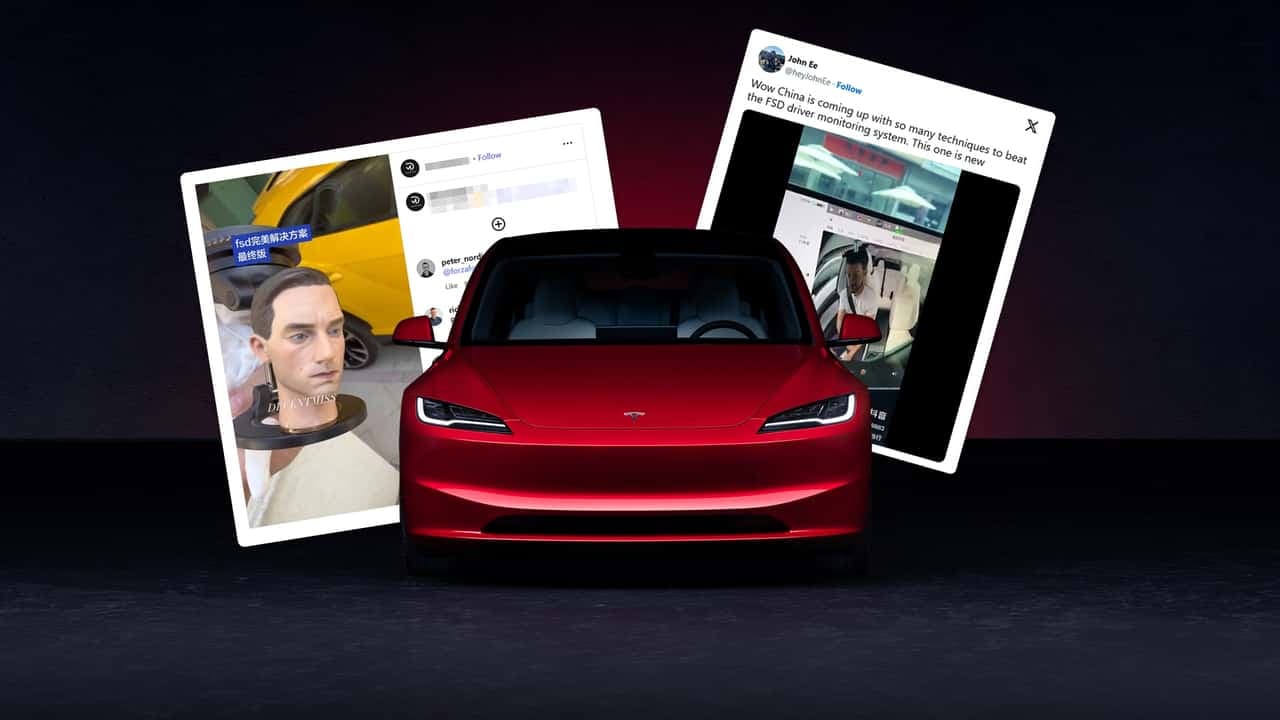
Tesla Owners Are Using Doll Heads to Fool Full Self-Driving — And It's a Serious Safety Problem
Imagine glancing over at the car next to you on the highway only to find Dwayne "The Rock" Johnson calmly riding shotgun — except it isn't him at all. It's a hyper-realistic doll head propped up in the driver's seat of a Tesla, placed there by an owner who wants to trick the car's driver monitoring system into thinking a real, attentive human is behind the wheel. It sounds absurd, but it's happening, and it raises deeply troubling questions about the current state of autonomous driving safety, regulatory oversight, and the lengths people will go to in order to bypass critical safeguards.
What Is Tesla's Driver Monitoring System?
Tesla's Full Self-Driving (FSD) software is one of the most talked-about and controversial features in the automotive industry. While it promises a future of hands-free, autonomous travel, Tesla's system is currently classified as a Level 2 driver assistance technology, meaning a human driver must remain alert, attentive, and ready to take control of the vehicle at any moment.
To enforce this requirement, Tesla uses an interior cabin camera — located above the rearview mirror — to monitor the driver's eye movements, head position, and general attentiveness. If the system detects that the driver is not looking at the road for an extended period, it issues warnings and can ultimately bring the vehicle to a stop. The intent is straightforward: keep a real, conscious human in the loop at all times.
This monitoring system exists because without it, drivers could theoretically fall asleep, leave the seat entirely, or otherwise disengage while the car handles driving duties — a scenario with obvious and potentially fatal consequences.
The Doll Head Exploit: How It Works
The workaround some Tesla owners have discovered is as creative as it is alarming. By placing a realistic, life-sized doll head — or in some viral examples, a likeness of a celebrity such as Dwayne Johnson — in a position that mimics a seated, forward-facing driver, owners have reportedly been able to satisfy Tesla's cabin camera long enough to go hands-free and, in some cases, entirely unoccupied by an attentive human.
The doll head essentially presents a static human-like face to the camera. Because the monitoring system relies on detecting facial geometry and general head orientation rather than micro-expressions or live biological signals, a convincing enough prop can fool it into registering an "attentive driver." The result is a car operating under FSD conditions with no genuinely alert person supervising its actions.
Videos and discussions of this exploit have circulated on social media platforms and Tesla owner forums, with some users treating it as a clever hack and others expressing genuine alarm at the implications.
Why This Is Far More Than a Quirky Internet Stunt
It would be easy to dismiss this as a fringe behavior practiced by a tiny handful of thrill-seeking Tesla enthusiasts. The reality, however, is that this kind of exploit exposes fundamental weaknesses in how driver monitoring technology currently works — and how seriously some users take the safety requirements attached to semi-autonomous driving systems.
The National Highway Traffic Safety Administration (NHTSA) has been investigating Tesla's FSD and Autopilot systems for years, particularly in relation to crashes involving inattentive drivers. When a driver uses a doll head to defeat monitoring, they are not simply bending the rules — they are removing the one human safeguard that stands between an imperfect AI system and a potentially deadly outcome on public roads.
- Tesla FSD cannot yet handle every real-world driving scenario reliably, including unexpected road debris, unusual traffic patterns, and complex urban intersections.
- Emergency situations require human reaction times and judgment that no current Level 2 system can fully replicate.
- Other road users — pedestrians, cyclists, and other drivers — have no say in the risk being imposed on them by an unmonitored autonomous vehicle.
The Broader Problem With Driver Monitoring Technology
Tesla's cabin camera approach is not unique to the company, but this incident highlights a shared weakness across the industry: current driver monitoring systems rely heavily on visual cues rather than multi-modal biometric verification. Competitors and regulators are increasingly aware that eye-tracking cameras and head-position detection alone are insufficient.
More advanced driver monitoring solutions incorporate steering wheel torque sensors, heart rate detection, infrared eye-tracking that measures blink rates and pupil dilation, and even capacitive touch sensors that detect skin contact. A multi-layered approach would make it significantly harder — ideally impossible — for a static prop to pass as an attentive driver.
Regulatory bodies in the European Union have already begun mandating more robust driver monitoring systems as part of new vehicle safety standards. The United States has been slower to act, but incidents like the doll head exploit will almost certainly add pressure on NHTSA and Congress to establish stricter requirements for any vehicle operating with advanced driver assistance features.
Tesla's Responsibility — and the Driver's
Tesla bears responsibility for continuously hardening its monitoring systems against known exploits. When a workaround gains enough public visibility to spread virally online, it becomes a known vulnerability — one the company is obligated to patch through software updates. At the same time, individual drivers who deliberately defeat safety systems are not merely voiding their warranty or risking a traffic citation. They are making a unilateral decision to put other people's lives at risk without those people's knowledge or consent.
Legal liability in crashes involving defeated monitoring systems is also murky territory. Insurance companies, lawyers, and courts are only beginning to grapple with questions of fault when a driver has actively circumvented a safety feature before an accident occurs.
What Should Tesla Do Next?
Addressing this vulnerability likely requires a combination of improved computer vision capable of detecting liveness — the difference between a real moving face and a static object — along with steering wheel grip detection, and possibly stricter regulatory compliance checks built into the FSD software itself. Tesla has the engineering talent and the over-the-air update infrastructure to deploy these improvements quickly. The real question is whether incidents like this one will be treated with the urgency they deserve.
Until more robust safeguards are in place, the doll head exploit serves as an uncomfortable reminder that the gap between marketing language around "Full Self-Driving" and the technical reality of Level 2 automation remains wide — and that some drivers are willing to exploit that gap in ways that put everyone on the road at risk.