
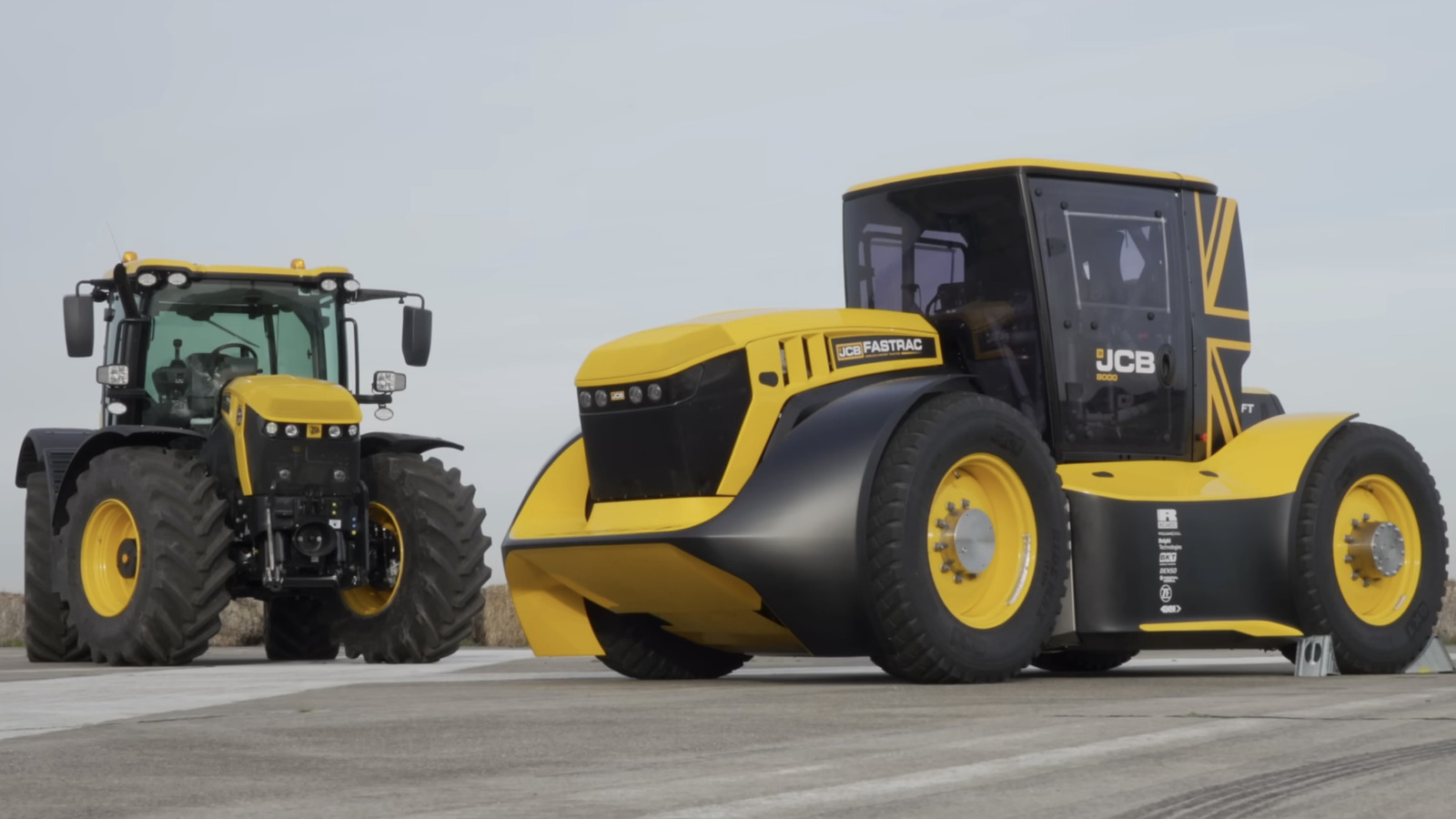
When Speed Meets the Farm: The World's Fastest Tractor
When most people picture a tractor, they imagine a lumbering, diesel-belching machine crawling across a muddy field at a pace that makes watching paint dry feel exciting. Tractors are built for torque, not speed — for pulling, not racing. That assumption, however, was spectacularly shattered when a team of engineers set out to create the world's fastest tractor. What they built wasn't just a novelty or a publicity stunt. It was a genuine feat of mechanical ingenuity, a purpose-built machine that forced the entire concept of what a tractor could be to be completely reimagined from the ground up.
The resulting vehicle holds a legitimate world record and stands as one of the most fascinating crossovers between agricultural machinery and high-performance engineering ever attempted. Understanding how it was built — and why so much had to be reinvented to make it possible — tells a compelling story about human obsession with speed and the surprising limits engineers have to push to achieve it.
Why Building a Fast Tractor Is Harder Than It Sounds
On the surface, making a tractor go fast might seem straightforward: just add a bigger engine and point it in a straight line. In practice, the engineering challenges are far more complex and numerous than most people would ever anticipate. Tractors are not designed with aerodynamics in mind. Their boxy frames, large exposed wheels, and high centers of gravity create enormous drag and instability at speed. Before a single horsepower could be added, engineers had to contend with fundamental questions of physics, safety, and mechanical integrity.
Standard tractor components — the axles, gearboxes, transmissions, and chassis — are engineered to handle stress at low speeds over rough terrain. Push those same components to highway speeds and beyond, and the forces acting on them multiply dramatically. Vibration, heat, and mechanical stress that would never appear in a normal working environment suddenly become critical engineering problems that can cause catastrophic failure. Every single system on the machine had to be evaluated, reinforced, or completely replaced.
The Role of Aerodynamics in Redefining the Tractor
One of the most visually striking aspects of a speed-record tractor is how different it looks from anything you'd find on a working farm. Achieving high speeds requires managing airflow with precision, which means the engineers had to apply the same aerodynamic thinking found in motorsport directly to a vehicle class where it had almost never been considered before.
Wind tunnel testing, computational fluid dynamics modeling, and careful bodywork design all played roles in reshaping the machine. The goal was to reduce drag as much as possible while maintaining enough downforce to keep the vehicle stable and planted to the ground at extraordinary speeds. Getting that balance right required countless iterations and a deep understanding of how air behaves around unconventional shapes — because a tractor, no matter how modified, is still a fundamentally unconventional shape for a speed machine.
Power, Transmission, and the Quest for Record-Breaking Speed
At the heart of any fast vehicle is its powertrain, and the world's fastest tractor is no exception. Engineers sourced and adapted high-output engines capable of producing far more power than any agricultural tractor would ever need in the field. But raw horsepower alone means nothing without a transmission system capable of channeling that power effectively to the wheels without disintegrating under the strain.
Conventional tractor gearboxes are designed for high-torque, low-speed applications. At record-breaking velocities, a standard agricultural transmission would fail almost immediately. The engineering team had to develop or source specialized transmission components that could handle both the power output and the rotational speeds involved. Driveshafts, differentials, and wheel hubs all required careful engineering attention to ensure that the drivetrain could survive conditions it was never originally designed to encounter.
Tires: The Unsung Heroes of the Record Attempt
Perhaps one of the most underappreciated engineering challenges in the entire project was the tires. Agricultural tires are built for grip in soft soil, not for high-speed stability on hard surfaces. At the speeds targeted by the record-breaking team, a standard tractor tire would overheat, deform, and potentially fail explosively — a terrifying outcome at any speed, let alone a record-setting one. Specially engineered tires, capable of withstanding the enormous centrifugal forces and heat generated at high velocity, had to be sourced and fitted to make the attempt even feasible.
Safety Engineering: Protecting the Driver at Extreme Speeds
Behind the wheel of the world's fastest tractor sat a human being, and keeping that person alive was just as important as breaking the record. Roll cages, fire suppression systems, racing harnesses, and aerodynamic stability systems all had to be integrated into a design that was never meant to carry any of them. The driver's cockpit was essentially rebuilt from scratch using motorsport safety standards, ensuring that in the event of an incident at speed, the human element of the equation had every possible protection available.
What the World's Fastest Tractor Proves About Engineering
Beyond the headline and the record, the world's fastest tractor stands as a remarkable case study in what determined engineering can accomplish when conventional wisdom is set aside. It proves that with enough creativity, expertise, and willingness to solve problems that have never been solved before, even the most unlikely vehicle can be transformed into something extraordinary.
For engineers, motorsport enthusiasts, and curious minds alike, it is a reminder that the line between what a machine is and what it could be is never as fixed as it seems — and that sometimes, the most interesting engineering stories begin with an idea that everyone else dismisses as impossible.