
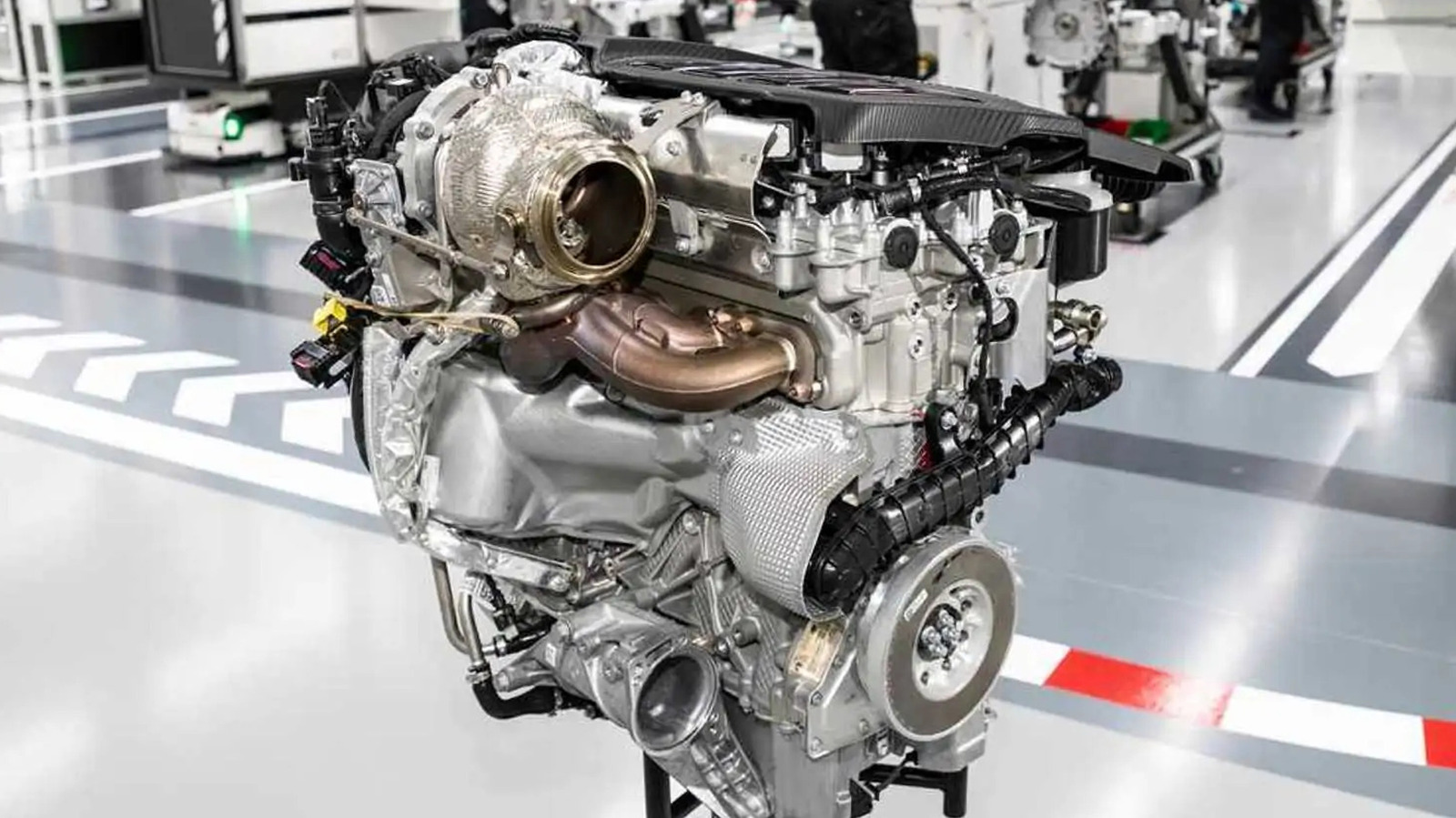
The Mercedes M139: Redefining What a Four-Cylinder Can Do
When most people think of a high-performance engine, they picture a thundering V8 or a silky-smooth inline-six. Four-cylinder engines, by comparison, tend to conjure images of economy cars and sensible commuters. Mercedes-AMG had other ideas. The Mercedes M139 engine shattered those expectations by becoming the most powerful series-production four-cylinder engine ever built — a title it still holds today. Yet despite that extraordinary achievement, the M139 has sparked a surprisingly passionate debate among drivers on both sides of the Atlantic. Loved in Britain, criticized in the United States, this engine tells a fascinating story about the gap between engineering excellence and real-world driver satisfaction.
What Is the Mercedes M139 Engine?
The M139 is a 2.0-liter turbocharged inline-four engine developed by Mercedes-AMG, the performance division of Mercedes-Benz. Introduced in 2019 and fitted to the AMG A 45 S and the AMG CLA 45 S, the engine produces a staggering 421 horsepower and 369 pound-feet of torque from just two liters of displacement. To put that in perspective, that works out to over 210 horsepower per liter — a specific output figure that rivals or surpasses many dedicated motorsport engines.
Achieving this kind of output from a comparatively small four-cylinder required Mercedes-AMG engineers to push the boundaries of production engine technology. The M139 features a twin-scroll turbocharger mounted on the exhaust side of the engine — a layout known as a "hot-V" configuration adapted for a four-cylinder — along with an advanced direct injection system, variable valve timing on both intake and exhaust camshafts, and a dry-sump lubrication system borrowed from motorsport applications. The result is an engine that breathes, spins, and performs in ways that no other volume-production four-cylinder has ever matched.
How Does It Compare to the Competition?
Before the M139 arrived, the benchmark for high-output four-cylinder engines was arguably set by Honda's legendary 2.0-liter unit found in the Civic Type R, or the similarly focused engines from Volkswagen's Golf R. While those engines are genuinely impressive in their own right, neither approaches the M139's output figures. Even Audi's turbocharged five-cylinder in the RS 3, which some consider a spiritual rival, uses an additional cylinder to reach comparable performance.
The M139 doesn't just lead in headline horsepower numbers. Its torque delivery, rev range, and overall architecture represent a generational leap in what turbocharged four-cylinder technology can achieve in a production road car. Mercedes-AMG engineers reportedly set a hard internal target: build the most powerful four-cylinder in the world, full stop. By any measurable standard, they succeeded.
Why American Critics Weren't Fully Convinced
Here is where the story gets genuinely interesting. Despite the M139's record-breaking credentials, American automotive journalists and enthusiasts were notably less enthusiastic than their British counterparts. The criticism in the United States tended to focus on a few recurring themes.
- Noise and character: Many U.S. reviewers noted that the M139, for all its power, simply doesn't sound like a performance engine should. Four-cylinders, even very fast ones, carry an inherent acoustic disadvantage compared to six- and eight-cylinder engines, and the M139 never fully escapes that reality. The exhaust note, while enhanced electronically in some driving modes, left a number of American reviewers feeling underwhelmed.
- Pricing versus value: The AMG A 45 S and CLA 45 S carry price tags that put them in direct competition with cars offering larger, more sonorous engines. American buyers evaluating those alternatives often found the emotional case for the M139-powered cars harder to make, even when the objective performance data clearly favored the Mercedes.
- Transmission concerns: The M139 is paired exclusively with AMG's eight-speed dual-clutch automatic transmission. While fast and capable, some American drivers found this combination less engaging than a traditional torque-converter automatic or a proper manual gearbox. The absence of a manual option was a recurring point of frustration in U.S. reviews.
Why the British Took a Different View
Across the Atlantic, the reception was considerably warmer. British automotive media and enthusiasts tended to celebrate exactly what the M139 represents: a triumph of precision engineering squeezed into a compact, practical package. The United Kingdom has a long tradition of appreciating hot hatches and performance compact cars, and the AMG A 45 S fits squarely into a segment that British buyers genuinely love.
UK reviewers frequently praised the M139's outright pace, its tractability in everyday driving, and the sheer novelty of having 421 horsepower available in a car that can still navigate narrow country lanes and urban traffic without drama. The emotional connection to the engine's character mattered less than its functional brilliance, and British automotive culture tends to reward that kind of engineering integrity.
The Legacy of the M139
Whatever your personal view on the sound of a four-cylinder engine, the M139's place in automotive history is already secure. It represents the absolute ceiling of what naturally aspirated and turbocharged engineering can currently extract from two liters and four cylinders in a road car sold to the public. That is not a trivial achievement.
Mercedes-AMG has since announced development of the M139L, an updated longitudinally mounted variant of the engine designed for use in future AMG models, suggesting that the M139 architecture has a long future ahead of it. The engineers who built it set out to make history, and they did exactly that.
Final Thoughts
The Mercedes M139 is proof that extraordinary engineering doesn't always translate directly into universal admiration. It is the most powerful production four-cylinder ever made, a genuine feat of modern automotive technology, and a milestone that competitors will be chasing for years to come. Whether you fall on the British side of the debate or the American one, there is no denying that Mercedes-AMG built something truly remarkable — even if remarkable doesn't always mean perfect for every driver in every market.