
Thailand's Pickup Market Faces Its Deepest Crisis in Decades
For much of the past two decades, the pickup truck was not just a vehicle in Thailand — it was a cultural and economic institution. Farmers, contractors, small business owners, and tradespeople relied on one-ton pickups as the backbone of their working lives. At its peak in 2012, the segment sold an impressive 593,000 units in a single year, cementing Thailand's status as one of Asia's most important pickup markets. Today, that dominance is crumbling at a pace that has alarmed automakers, economists, and industry analysts alike.
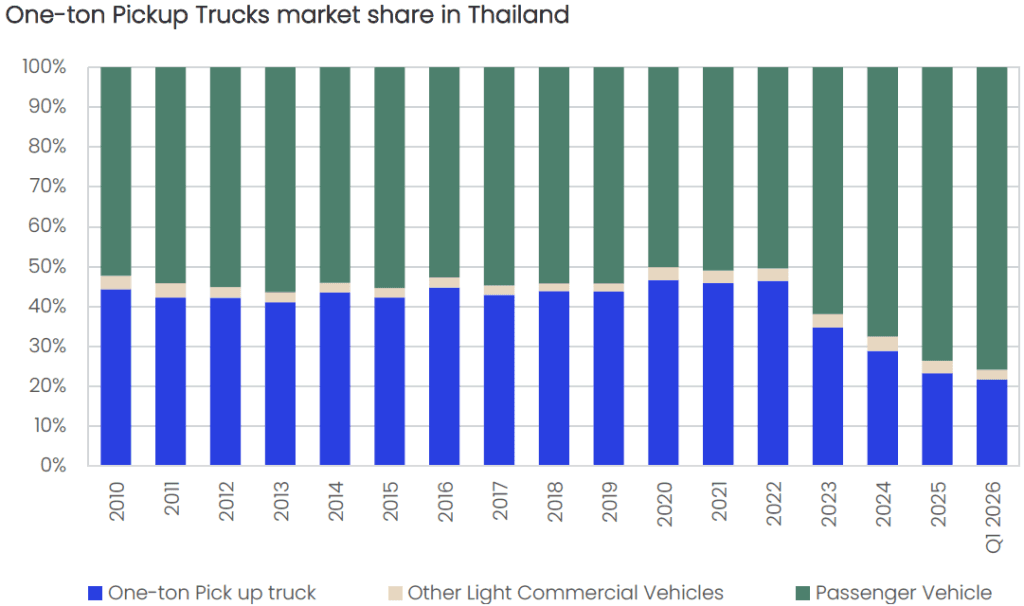
In 2024, annual sales of one-ton pickups collapsed to just 144,000 units — a staggering decline that represents less than a quarter of the 2012 peak. The market share figures tell an equally sobering story. Pickups once accounted for 40 to 50 percent of Thailand's total Light Vehicle (LV) market. That share stood at 46% in 2022, but has since fallen sharply: to 35% in 2023, 29% in 2024, and just 23% in 2025. Understanding what is driving this historic contraction requires looking at both the immediate pressures squeezing consumers and the deeper structural changes reshaping Thailand's automotive landscape.
Tighter Credit Conditions: The Most Immediate Pressure
One of the most direct forces suppressing pickup sales in Thailand has been a significant tightening of credit conditions. Thai consumers have historically relied heavily on auto financing to purchase new vehicles, and the pickup segment — which skews toward working-class and rural buyers — is particularly sensitive to lending standards and interest rate movements.
As financial institutions have become more cautious in their lending, approval rates for vehicle loans have declined and down payment requirements have increased. For buyers who depend on credit to make a purchase viable, these changes have proven to be a decisive barrier. Many prospective pickup buyers have simply been priced out of the market, not because the vehicles are more expensive, but because the pathway to financing them has narrowed considerably.
This credit squeeze has coincided with a broader period of household financial stress in Thailand. Rising living costs, persistent inflation in food and energy prices, and sluggish wage growth have stretched the budgets of the rural and semi-urban households that form the core of the pickup market. When disposable income contracts, big-ticket discretionary purchases like new vehicles are among the first casualties.
Structural Shifts Are Reshaping Long-Term Demand
Beyond the cyclical economic headwinds, Thailand's pickup market is also contending with longer-term structural changes that are likely to have lasting effects on demand. Perhaps the most significant of these is the gradual transformation of Thailand's agricultural and rural economy — historically the heartland of pickup truck ownership.
As Thailand's economy modernises and urbanises, the traditional use case for a one-ton pickup — hauling goods, navigating rough rural roads, supporting farm operations — is becoming less universally relevant. A growing segment of the population now lives and works in urban environments where a large pickup truck is impractical, expensive to run, and difficult to park. These consumers are increasingly gravitating toward passenger cars, compact SUVs, and increasingly, electric vehicles (EVs).
The rise of Chinese EVs in Thailand has added a new and disruptive dynamic to the market. Brands such as BYD, MG, and SAIC have aggressively expanded their presence in Thailand, offering competitively priced electric passenger vehicles that appeal to urban consumers looking for modern, efficient, and technologically advanced transportation. While EV pickup trucks remain a relatively niche category globally, the broader EV wave is drawing consumer attention — and spending — away from traditional internal combustion engine pickups.
What This Means for Automakers in Thailand
The pickup market's decline poses a serious challenge for the automakers who have built substantial production and export operations in Thailand around this segment. Japan's major manufacturers — Toyota, Isuzu, Mitsubishi, and Ford — have long used Thailand as a regional hub for pickup truck production, with vehicles built there exported across Southeast Asia, Australia, and beyond.
A sustained contraction in domestic demand does not necessarily undermine the export rationale immediately, but it does signal a weakening home-market foundation that can affect investment decisions, production volumes, and supplier ecosystems over time. If domestic sales remain depressed, automakers may need to recalibrate their Thai manufacturing strategies, potentially shifting capacity toward other vehicle types or accelerating their transition to EV production.
Some manufacturers have already begun exploring electrified pickup concepts for the Thai and regional markets, but translating these concepts into commercially viable, affordably priced products that satisfy the practical demands of Thai buyers remains a significant challenge.
Is a Recovery on the Horizon?
While the current picture is undeniably bleak, not all analysts are writing off a future recovery. If credit conditions ease, household incomes stabilise, and economic confidence returns, there is a base of latent demand that could support a partial rebound in pickup sales. Thailand's rural and commercial sectors still have genuine, enduring needs for capable utility vehicles.
However, it is increasingly unlikely that the market will return to the heights of the 2012 peak. The structural shifts underway — urbanisation, the rise of EVs, changing consumer preferences among younger buyers — represent durable changes rather than temporary disruptions. A "new normal" for Thailand's pickup market will almost certainly be smaller, more competitive, and more technology-driven than the one that defined it for the previous two decades.
A Market at a Crossroads
Thailand's pickup truck market stands at a genuine crossroads. The combination of economic stress, tighter credit, shifting demographics, and the disruptive arrival of electric vehicles has dismantled what once seemed like an unshakeable market structure. For automakers, suppliers, policymakers, and investors with exposure to Thailand's automotive sector, the message is clear: the old assumptions about this market no longer hold, and the strategies built around them urgently need revisiting. How stakeholders respond to this transition will shape the trajectory of one of Southeast Asia's most important vehicle segments for years to come.