
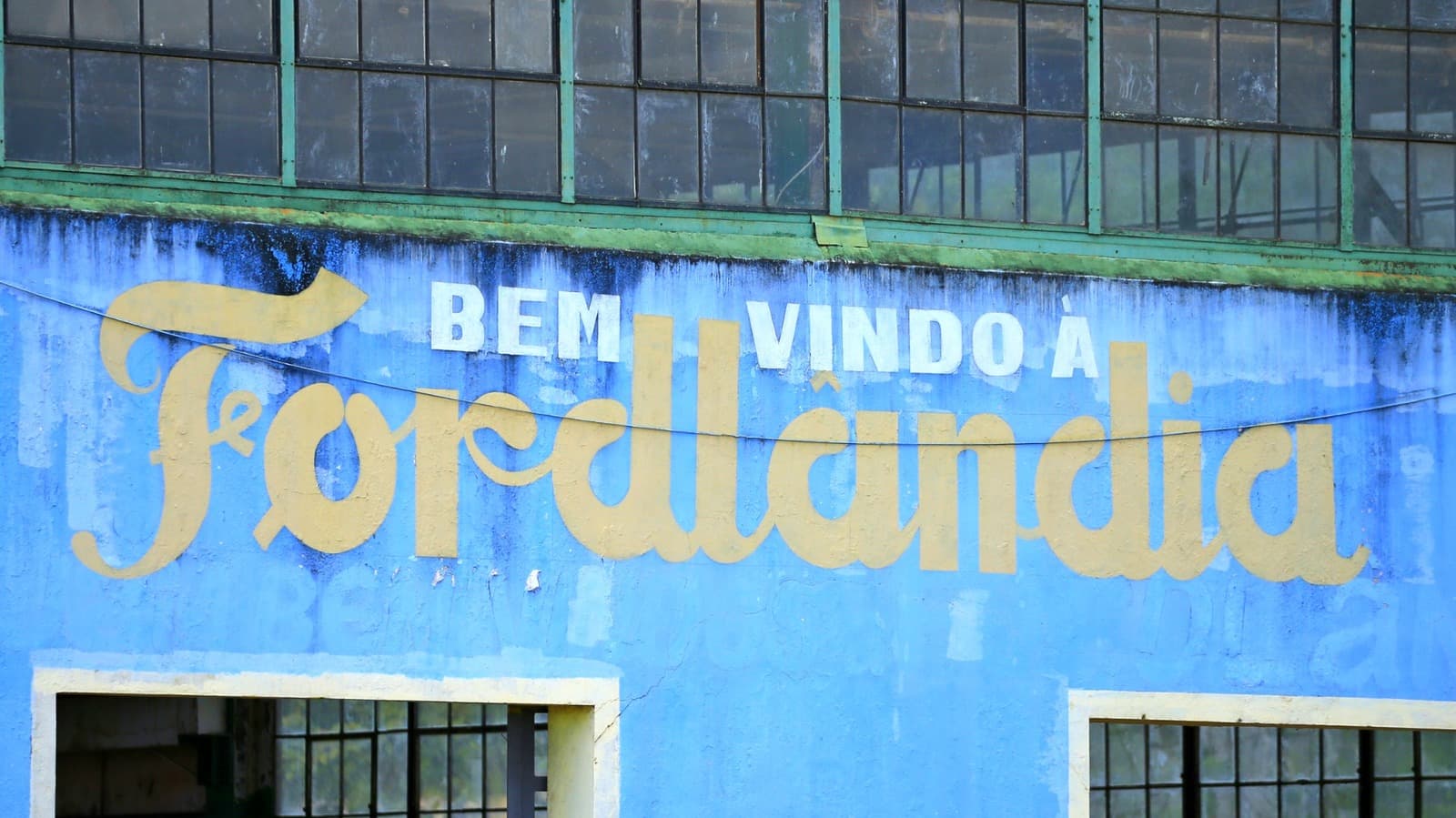
Fordlandia: The Rise and Fall of Henry Ford's Amazon Dream
Deep in the heart of the Brazilian Amazon, the ruins of an unlikely American experiment have stood for nearly a century. Fordlandia — a planned industrial city built by Henry Ford in the late 1920s — was once meant to be the crown jewel of a global rubber empire. Today, Brazilian courts have ordered its restoration, bringing renewed global attention to one of history's most ambitious and spectacular failures.
What Was Fordlandia?
Fordlandia was a company town established by the Ford Motor Company in 1928 on the banks of the Tapajós River in the state of Pará, Brazil. Henry Ford's vision was sweeping in its ambition: create a self-sustaining rubber plantation colony that would supply the Ford Motor Company with an independent source of natural rubber, freeing it from the grip of British-controlled rubber markets in Southeast Asia.
The project covered approximately 10,000 square kilometers of jungle — a landmass larger than the state of Connecticut. Ford envisioned not just a plantation, but a fully functioning American-style town transplanted into the tropics. The settlement included:
- Paved roads and electricity-lit streets
- American-style wooden houses for workers
- A hospital, school, and golf course
- A power plant, sawmill, and Ford-branded infrastructure
- A dining hall that served American food — including hamburgers and whole wheat bread
Ford's intention was not merely economic. He believed that the discipline and moral framework of Midwestern American life could be exported anywhere. Alcohol was banned, and workers were encouraged to follow wholesome routines in line with Ford's paternalistic social philosophy.
Why Did Fordlandia Fail?
Despite the enormous investment — Ford reportedly spent over $20 million on the project, equivalent to hundreds of millions in today's dollars — Fordlandia was a catastrophic failure. The reasons were multiple and, in hindsight, almost inevitable.
Agricultural Miscalculations
Ford's agricultural team planted rubber trees in dense, monoculture rows, which is fundamentally contrary to how rubber trees grow naturally in the Amazon. In the wild, rubber trees are scattered across the forest, a natural defense against the South American leaf blight fungus (Microcyclus ulei). Planted densely together, the trees became easy targets for the disease, and plantation after plantation was decimated. Ford's team lacked the local botanical knowledge that could have prevented this outcome, and the company stubbornly refused to hire experts who might have advised differently.
Cultural and Labor Conflicts
The imposition of American cultural norms on Brazilian workers led to serious unrest. Workers resented the alcohol ban, the mandatory American-style food, and the rigid scheduling. In December 1930, a full-scale riot broke out in the town's cafeteria. Brazilian workers overturned tables, smashed equipment, and drove American managers into the jungle, where they hid until Brazilian army troops arrived to restore order.
Environmental Incompatibility
The Amazon's climate — relentless humidity, swarms of insects, extreme heat — was poorly understood by Ford's planners. Workers suffered high rates of malaria, yellow fever, and other tropical diseases. The infrastructure, built on American templates, was not suited to the jungle environment. Even the imported American food rotted quickly in the tropical heat.
Abandonment and Decades of Decay
After years of losses and failed attempts to relocate the plantation downstream to a second site called Belterra — which fared only marginally better — Ford Motor Company finally sold the entire operation back to the Brazilian government in 1945 for just $250,000, a fraction of what had been invested. The company walked away without ceremony, and Fordlandia was left to the jungle.
By the time Ford's representatives departed, around 3,000 people lived in the settlement. Most left gradually over the following decades. Nature began reclaiming the streets, the rusting water tower, the skeletal buildings, and the miles of unused railroad track. Today, a small community of a few hundred people still lives among Fordlandia's ghostly remains.
The Push for Heritage Preservation
Since the 1990s, local preservationists and historians have been fighting to have Fordlandia recognized as a protected cultural heritage site. Their argument is compelling: Fordlandia is a unique and irreplaceable artifact of early 20th-century industrial capitalism, American expansionism, and the complex relationship between the global north and the Amazon region.
Their efforts have now culminated in a landmark legal development. Brazilian courts have officially ordered the restoration of Fordlandia, recognizing its historical and cultural significance. The ruling represents a major victory for the preservation community and could transform the crumbling ghost town into one of the Amazon's most significant historical tourism destinations.
What Does Restoration Mean for Fordlandia?
The court-ordered restoration is expected to address the severe structural deterioration that has overtaken Ford's original buildings. Key priorities will likely include stabilizing the water tower — Fordlandia's most iconic and photographed landmark — restoring the hospital and school buildings, and preserving the street grid and residential structures that still reflect their 1920s American character.
Beyond physical restoration, the project presents an opportunity to tell a nuanced, honest story about Fordlandia's legacy — one that acknowledges both the audacity of Ford's vision and the cultural arrogance, ecological ignorance, and human cost that accompanied it. For the Brazilian communities of the Tapajós River region, the story of Fordlandia is not simply a curiosity about an eccentric billionaire. It is a chapter in a longer history of outside powers attempting to exploit the Amazon and its people.
Fordlandia's Enduring Fascination
Fordlandia has captured the imagination of writers, historians, filmmakers, and travelers for decades. Greg Grandin's 2009 book Fordlandia: The Rise and Fall of Henry Ford's Forgotten Jungle City brought widespread international attention to the story and remains the definitive account of the project. The site has since become a destination for adventurous tourists willing to make the long river journey from Santarém.
Its appeal lies in its paradoxes: the collision of industrial modernity with primordial jungle, the hubris of one of the 20th century's most powerful men meeting the humbling reality of the natural world. In an era when conversations about corporate power in the Amazon are more urgent than ever, Fordlandia reads almost as a cautionary parable.
Conclusion: A Ghost Town Gets a Second Chance
The Brazilian court's order to restore Fordlandia is more than a preservation victory. It is an acknowledgment that even failed dreams leave behind histories worth protecting. As restoration work begins, the world will have the chance to visit, study, and reflect on a place where one man's industrial ambition collided with one of the planet's most powerful ecosystems — and lost. Henry Ford's Amazon rubber empire never produced the wealth he imagined, but Fordlandia may yet find its purpose as a monument to the limits of human overreach and the resilience of the communities and landscapes that survived it.