
Western European Car Sales Post Fourth Consecutive Month of Growth in May 2026
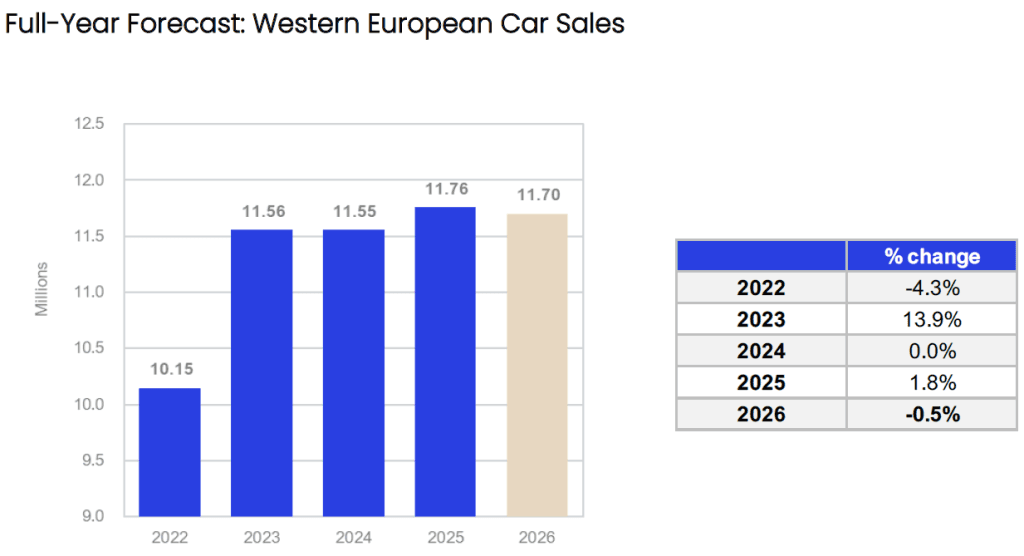
The Western European passenger vehicle (PV) market has demonstrated notable resilience in the face of persistent economic pressures, recording a 3.2% year-on-year increase in sales during May 2026. This marks the fourth consecutive month of growth for the region, signaling a sustained recovery trajectory even as broader macroeconomic conditions continue to create friction for consumers and automakers alike. Year-to-date sales now stand at 5.2 million units, reflecting a 4.5% increase compared to the first five months of 2025 — a figure that underscores the market's underlying momentum.
While the selling rate dipped slightly to 11.9 million units per year, the overall direction of travel remains positive. Analysts point to a confluence of structural and policy-driven factors as the key forces behind this growth, most notably a dramatic acceleration in battery electric vehicle (BEV) adoption and the increasingly competitive pricing strategies employed by international manufacturers entering the European arena.
A Structural Realignment Reshaping the European Auto Industry
Perhaps the most significant story unfolding beneath the headline growth numbers is the deep structural realignment now reshaping the Western European automotive landscape. Traditional internal combustion engine (ICE) vehicle sales have contracted sharply, a trend that has been building for several years but appears to be entering a more decisive phase. Far from dragging the overall market into decline, however, this contraction is being actively offset by the rapid uptake of battery electric vehicles across the region.
This dynamic mirrors patterns that have been observed most prominently in Germany, where policy frameworks and consumer incentives have helped drive a meaningful shift in purchasing behavior. The broader Western European market is now following a similar path, with supportive regulatory environments playing a critical enabling role. Emissions targets, purchase incentive schemes, and the gradual expansion of public charging infrastructure have collectively lowered the barriers to EV adoption for a growing segment of European car buyers.
The Role of Competitively Priced International Manufacturers
One of the more disruptive forces accelerating this shift is the arrival of competitively priced international manufacturers — particularly from China — who are offering BEV models at price points that established European brands have struggled to match. These new entrants are not merely filling a gap in the market; they are actively redefining consumer expectations around value, technology, and affordability in the electric vehicle segment.
For legacy European automakers, this represents both a challenge and a catalyst. The competitive pressure is forcing incumbents to accelerate their own electrification strategies, streamline production costs, and rethink their positioning in entry-level and mid-market segments. The net result, at least in the near term, is a more dynamic and competitive marketplace that is expanding the overall pool of EV buyers and contributing to the positive sales trajectory seen in recent months.
Macroeconomic Headwinds Remain a Persistent Concern
Despite the encouraging headline numbers, market observers are careful not to overstate the case for optimism. A series of macroeconomic headwinds continue to weigh on consumer purchasing power across Western Europe, creating conditions that could temper growth or introduce volatility in the months ahead.
- Rising interest rates: With central banks maintaining a cautious stance on monetary easing, borrowing costs for consumers financing new vehicle purchases remain elevated. This is particularly impactful in a segment where a significant proportion of transactions are financed through loans or leasing arrangements.
- Sticky inflation: While headline inflation figures have moderated from their recent peaks, core inflation — encompassing goods and services central to household budgets — has proven more stubborn. This continues to erode real disposable income and forces consumers to prioritize spending carefully.
- Volatile energy prices: Fluctuating energy costs create uncertainty both for consumers evaluating the total cost of ownership for new vehicles and for manufacturers managing input costs across their supply chains.
Together, these factors mean that any further expansion of the Western European PV market cannot be taken for granted. The resilience demonstrated over the past four months reflects genuine structural and policy tailwinds, but it is being tested by a challenging macroeconomic backdrop that shows few signs of fully resolving in the near term.
BEV Adoption as the Market's Primary Growth Engine
Looking at the broader picture, battery electric vehicles are increasingly functioning as the primary engine of market growth across Western Europe. As ICE sales continue their structural decline, the pace at which BEV adoption can accelerate will be central to determining whether the region's automotive market expands, stabilizes, or contracts in coming years.
The early indicators from 2026 are cautiously encouraging. The policy environment across most Western European nations remains broadly supportive of electrification, with several governments maintaining or extending purchase incentives and investing in charging infrastructure. At the same time, the growing presence of affordable international BEV options is widening the demographic reach of electric vehicles beyond early adopters and premium buyers.
What to Watch in the Second Half of 2026
As the year progresses, several factors will be worth monitoring closely. The evolution of interest rate policy by the European Central Bank and national monetary authorities will have a direct bearing on consumer financing conditions. Any easing of rates could provide a meaningful boost to new vehicle purchases, while continued tightening would add further pressure to an already stretched consumer base.
The competitive dynamics among international BEV manufacturers entering the European market will also be worth watching. As more models reach dealerships and brand awareness grows, the pace of consumer adoption could accelerate further — particularly if pricing remains aggressive and product quality continues to improve.
Conclusion: Resilience Built on a Shifting Foundation
The Western European passenger vehicle market's four-month growth streak represents a genuine achievement in a difficult environment. Driven by accelerating BEV adoption, supportive policy frameworks, and the arrival of competitively priced international players, the market is navigating its structural transition more effectively than many feared. However, the macroeconomic headwinds of rising interest rates, persistent inflation, and energy price volatility serve as a reminder that this resilience is not unconditional. The road ahead for European auto sales remains promising but not without significant bumps.