
A History That Was Never Chosen
There is a quiet gravity to the words spoken by many of Taiwan's indigenous elders when the subject of China's military posture arises: "The current situation is not the fruit of our choosing, but of history itself." In Hualien — a coastal city nestled between towering mountains and the Pacific Ocean, long considered the spiritual heartland of Taiwan's Austronesian peoples — this sentiment carries particular weight. To understand how the China threat is perceived through indigenous eyes, one must first understand that these communities have already survived multiple waves of colonialism, displacement, and forced assimilation. The present geopolitical tension is, for many of them, simply the latest chapter in a very long story.
Hualien: More Than a Geographic Flashpoint
When international analysts discuss Taiwan's vulnerability to a potential Chinese military action, Hualien frequently appears on their maps. Its eastern coastline, relative distance from major urban centers like Taipei, and proximity to open Pacific waters make it a point of strategic interest. Military planners note its airports, its access routes through the Central Mountain Range, and its potential role in any conflict scenario involving the Taiwan Strait.
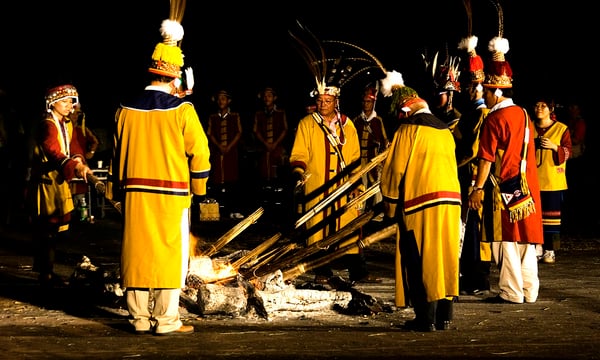
But for the Amis, Truku, Bunun, and other indigenous nations who call this region home, Hualien is not primarily a tactical coordinate. It is ancestral land. It is the site of oral histories, ceremonial cycles, and a relationship with the natural world that predates the arrival of Han Chinese settlers, Japanese colonizers, and the Republic of China government by centuries. When outsiders speak of Hualien as a potential theater of war, indigenous residents hear something more personal — a threat not just to a nation-state, but to everything that has survived against remarkable odds.
Layers of Colonialism, Layers of Survival
Taiwan's indigenous peoples — collectively known in Mandarin as yuánzhùmín — represent approximately 2.5 percent of Taiwan's total population, with sixteen officially recognized nations. Their history is one of repeated dispossession. The Qing dynasty pushed them into mountain territories. Japanese colonial administration conducted violent "pacification" campaigns and reshaped indigenous economies to serve imperial needs. After 1949, Kuomintang policies promoted Mandarin language education and suppressed indigenous languages and cultural practices under the banner of national unity.
The democratic reforms of the 1990s and 2000s brought legal recognition, cultural revival programs, and a growing political voice. Indigenous legislators now sit in Taiwan's parliament. Land rights campaigns have won partial victories. Young Amis musicians blend traditional polyphony with contemporary forms and reach global audiences. There is genuine, hard-earned progress. Yet the structural disadvantages — in income, in land ownership, in educational attainment — remain significant. When the conversation turns to the China threat, many indigenous voices ask a pointed question: which version of Taiwan are we being asked to defend, and will that Taiwan defend us in return?
What Beijing's Narrative Means for Indigenous Identity
The People's Republic of China frames its claim over Taiwan primarily through the language of Han Chinese ethnic and cultural unity — a "reunification" of people who share a common civilization. This framing is not merely politically contentious for Taiwan's mainstream population; for indigenous Taiwanese, it is existentially alien. The Austronesian peoples of Taiwan share linguistic and genetic heritage with populations across Southeast Asia, the Pacific Islands, and Madagascar. Their roots on the island stretch back at least six thousand years. They are not part of a Han narrative. They never were.
When Beijing speaks of recovering a lost province, it is describing a territory whose oldest inhabitants have no meaningful place in that story. Indigenous activists and scholars have noted with some bitterness that both the PRC and, historically, the ROC have treated Taiwan's first peoples as peripheral footnotes in a dispute between Chinese political parties. The cross-strait conflict, as it is commonly framed, erases indigenous presence almost entirely.
Fear, Pragmatism, and a Complicated Loyalty
Polling and ethnographic research conducted in indigenous communities across eastern Taiwan reveal a complex picture. There is no single indigenous position on the question of Taiwan's political future. Some communities, particularly those with strong ties to the ROC military — where indigenous men have historically been overrepresented — express deep loyalty to the existing state. Others, influenced by Indigenous rights movements and transnational solidarity networks, are more critical of Taipei and more skeptical of what any centralized government ultimately means for their autonomy.
What most share is a sober, unsentimental realism about conflict. Communities in Hualien have direct experience with natural disasters — earthquakes, typhoons, floods — that have tested infrastructure and emergency response repeatedly. They are not naive about what armed conflict would mean for mountain villages, for coastal settlements, for ceremonial sites that cannot be evacuated or rebuilt. The prospect of war is not abstract. It is imagined in specific, local, painful terms.
The Long View: History as Both Burden and Resource
Perhaps the most striking aspect of indigenous perspectives on the China threat is the temporal scale on which many community members operate. Where politicians and journalists tend to focus on the last decade or the next election cycle, indigenous elders and cultural leaders speak in generations. They have seen governments come and go, ideologies rise and fall, maps redrawn without their consent.
This long view is not passive fatalism. It is, in many cases, the foundation of a determined cultural resilience. Languages that were nearly extinguished are being taught to children again. Land claims that seemed permanently lost are being reopened in courts. Young indigenous professionals are entering fields — law, medicine, environmental science, politics — that were largely closed to their grandparents. The survival instinct is active and forward-looking.
A Question the World Should Be Asking
International discourse on the Taiwan Strait tends to center on semiconductor supply chains, democratic values, and great-power competition. These are legitimate concerns. But the lens of Taiwan's indigenous peoples offers something that strategic analysis often misses: a reminder that the land at the center of this dispute has its own deep human story, one that neither Beijing nor Taipei fully owns.
As tensions in the region continue to evolve, listening to the voices rising from Hualien's valleys and coastlines is not merely an act of cultural sensitivity. It is an act of intellectual honesty. The current situation may not be the fruit of their choosing — but how it resolves will shape their world as profoundly as anyone's.