
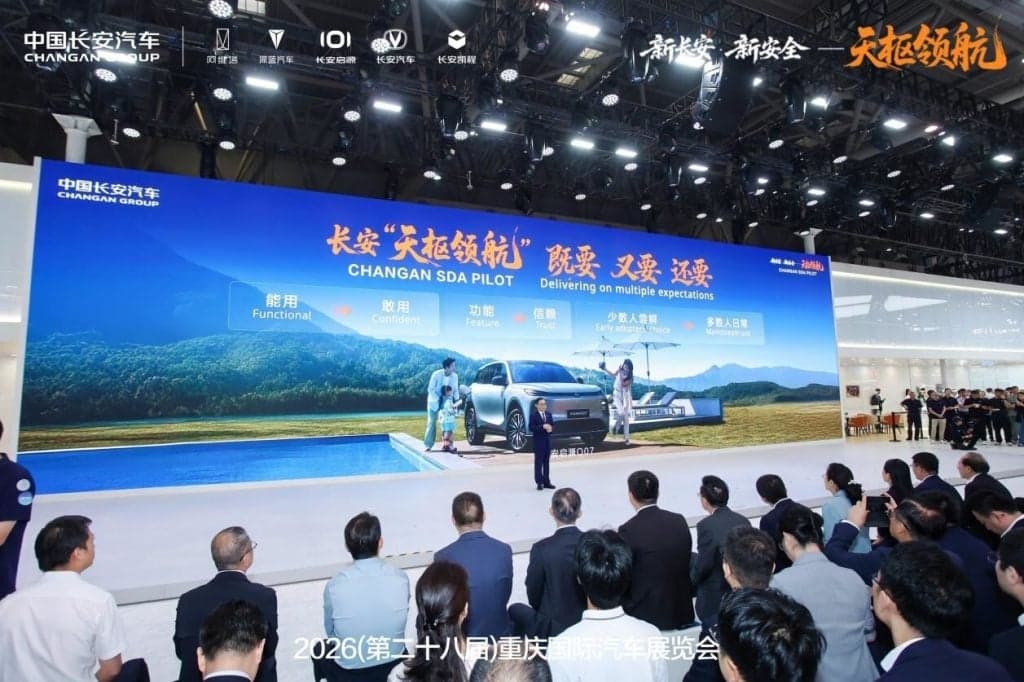
Changan Group Launches SDA Pilot at the 28th Chongqing International Auto Exhibition
The global automotive industry took notice when Changan Group, one of China's most prominent automakers, stepped onto the stage at the 28th Chongqing International Auto Exhibition to officially unveil SDA Pilot — its entirely self-developed Advanced Driver-Assistance System. The announcement marks a significant milestone not only for Changan but for the broader landscape of intelligent vehicle technology emerging from China. With a clear vision and a tiered product architecture, SDA Pilot positions Changan as a serious contender in the rapidly evolving ADAS market.
A Vision Rooted in Safety, Accessibility, and Smart Technology
At the heart of the SDA Pilot launch was a powerful message from the top. Zhu Huarong, Chairman of Changan Group, addressed the audience with a statement that set the tone for the system's philosophy: "Changan will work together with partners and users worldwide to make ADAS better, more practical, and more accessible, protecting every journey with smart technology."
These words reflect a broader shift in how Chinese automakers are approaching driver assistance technology — not merely as a premium feature reserved for high-end trims, but as a democratised safety tool that should be available to as many drivers as possible. Accessibility, practicality, and genuine protection appear to be the three pillars on which Changan is building its ADAS strategy going forward.
Breaking the Boundaries of Traditional Physical Safety
What makes SDA Pilot particularly noteworthy is Changan's bold claim that the system goes beyond conventional driver-assistance frameworks. According to the company, SDA Pilot does not simply address physical safety — it establishes three comprehensive safety defence systems that cover physical well-being, mental comfort, and emotional interaction.
This three-dimensional approach to safety is a departure from the industry norm, which has traditionally focused almost exclusively on collision avoidance, lane-keeping, and emergency braking. By incorporating mental comfort and emotional interaction into the safety equation, Changan appears to be positioning SDA Pilot as a holistic driving experience platform rather than a purely reactive safety mechanism. It is an ambitious framing, and one that will be watched closely by industry analysts and competitors alike.
Understanding the Three Tiers of SDA Pilot
SDA Pilot is structured across three distinct tiers — Pro, Max, and Ultra — each offering progressively advanced capabilities designed to meet the needs of different drivers and use cases.
SDA Pilot Pro: LiDAR-Powered Entry-Level Safety
The entry-level SDA Pilot Pro already comes with an impressive specification that many competitors reserve for higher trims. Most notably, it comes standard with LiDAR technology, a sensor typically associated with premium autonomous and semi-autonomous vehicles. Changan claims that this LiDAR integration allows the system to identify obstacles in low-light conditions — such as at night or inside tunnels — a full two seconds faster than the human eye can perceive them.
That two-second advantage is not a trivial figure. At highway speeds, two seconds can represent the difference between a near-miss and a serious collision. The system is further supported by the SDA Central Ring Network Architecture, which Changan says reduces response time by an additional 150 milliseconds, further sharpening the system's real-world reaction capabilities.
SDA Pilot Max: Data-Driven Intelligence for Complex Commutes
Moving up the tier ladder, SDA Pilot Max leverages over 20 million high-quality real-world driving data segments that have been used to train the system's perception and predictive algorithms. This vast dataset allows the system to deliver what Changan describes as "exceptional perception and predictive capabilities to confidently navigate complex, high-frequency commuting scenarios."
For urban drivers navigating dense city traffic, unpredictable road users, and constantly shifting conditions, this level of data-backed intelligence could make a meaningful difference in daily driving confidence and safety. The emphasis on commuting scenarios suggests Changan has deliberately targeted the real-world pain points of its core customer base in China's bustling metropolitan areas.
SDA Pilot Ultra: Vision Language Models and the Intuitive Travel Companion
At the pinnacle of the SDA Pilot range sits the Ultra tier, which introduces an integration with a Vision Language Model (VLM). This technology significantly enhances the vehicle's environmental perception by combining visual data processing with language-based reasoning, enabling more nuanced interpretation of the driving environment.
Perhaps most strikingly, the VLM integration enables what Changan calls "interactive advanced driver-assistance functions," effectively turning the vehicle into what the company describes as "an intuitive travel companion." This suggests a future where the car does not simply respond to physical inputs but engages with the driver in a more communicative, contextually aware manner — a concept that aligns closely with the growing industry interest in human-machine interaction and AI-powered cockpit experiences.
The Changan NEVO Q06: SDA Pilot's First Production Vehicle
SDA Pilot will make its production debut in the Changan NEVO Q06, a model that will come standard with the system across all trim levels. The NEVO Q06 is expected to enter China's domestic market in the second half of 2026, making it one of the first mass-market vehicles to offer a LiDAR-equipped ADAS as standard across the entire range rather than as an optional upgrade.
This decision to standardise SDA Pilot across all trims of the NEVO Q06 is a strong signal of Changan's commitment to the democratisation of ADAS technology — and a potentially disruptive move in a segment where advanced safety features are still frequently used as upsell tools.
What SDA Pilot Means for the ADAS Landscape
Changan's SDA Pilot launch is more than a product announcement. It represents a statement of intent from one of China's automotive giants in the intensely competitive race toward intelligent, connected, and ultimately autonomous vehicles. By developing ADAS in-house, Changan retains full control over software iteration, data integration, and system evolution — a strategic advantage that is increasingly recognised as critical in the era of software-defined vehicles.
As global automakers and technology companies continue to pour investment into driver-assistance and autonomous driving systems, the arrival of a vertically integrated, tiered ADAS platform from Changan adds another compelling chapter to the story of China's automotive ambition. With SDA Pilot, Changan is not just protecting drivers — it is staking its claim in the future of mobility.