
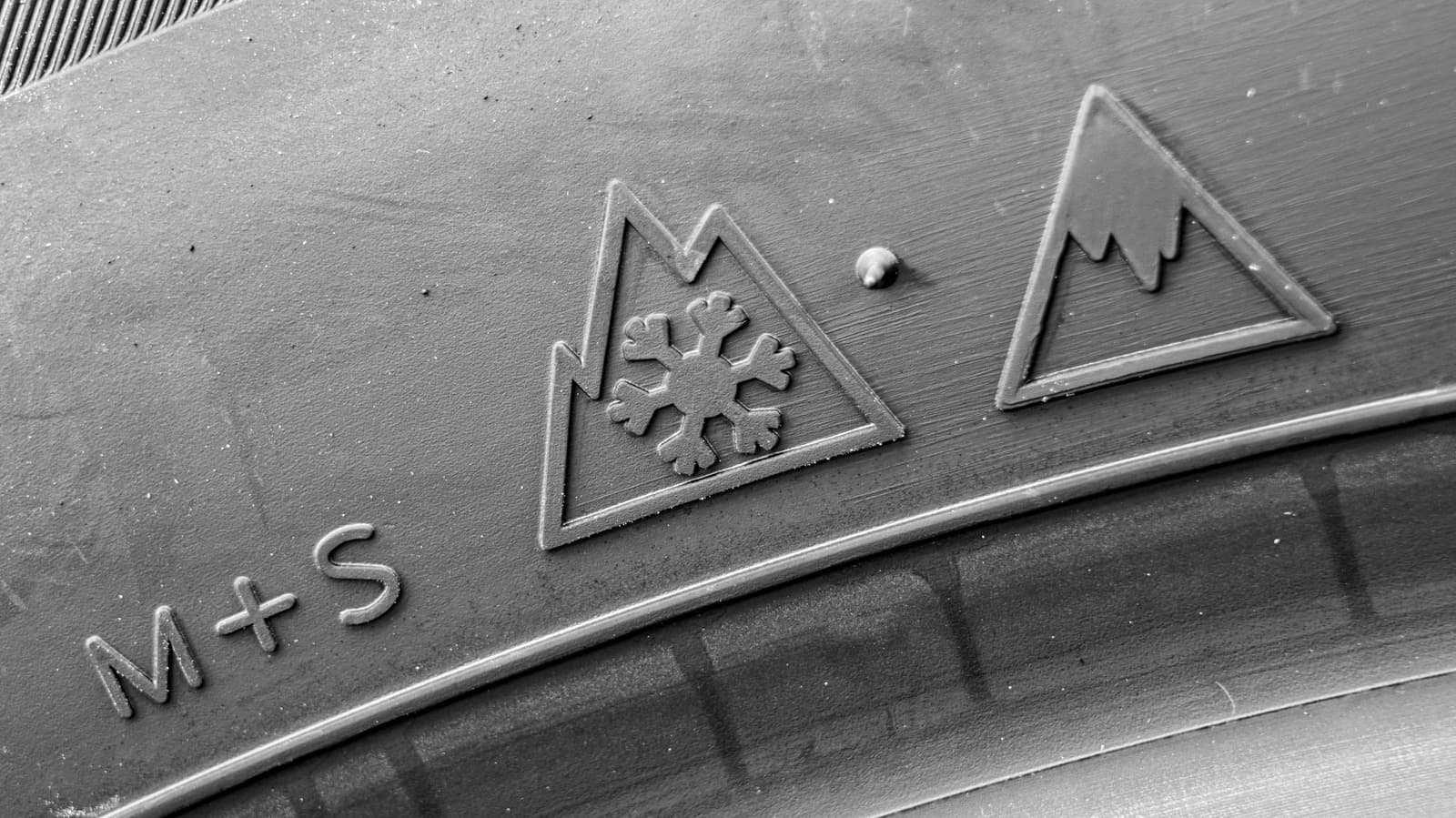
What That Small Mountain Symbol on Your Tire Sidewall Actually Means
If you've ever crouched down beside your car, squinted at the sidewall of a tire, and spotted a small jagged mountain peak with a snowflake inside it, you've encountered one of the most important — and most misunderstood — symbols in the automotive world. It looks simple enough, almost like a tiny winter landscape stamp, but earning that little icon requires a tire to pass some seriously demanding real-world tests. Understanding what it means could genuinely influence the safety of every winter drive you take.
The Symbol Has a Name: The Three Peak Mountain Snowflake
The official name of this icon is the Three Peak Mountain Snowflake, commonly abbreviated as 3PMSF. It depicts three mountain peaks with a snowflake centered in the middle, and its presence on a tire sidewall is a certified indication that the tire has met specific performance standards for severe winter conditions. This is not a marketing badge or a decorative design choice — it is a standardized certification recognized across North America and increasingly accepted throughout Europe and other international markets.
The symbol was developed jointly by the Rubber Association of Canada (RAC) and the U.S. Tire Manufacturers Association (USTMA), and it serves as the benchmark for identifying tires that are genuinely engineered for winter use. When you see 3PMSF on a sidewall, you know that tire has been independently tested and verified to perform in snow — not just marketed as if it can.
Don't Confuse It With the M+S Rating
Here's where many drivers get tripped up. For years, tires stamped with M+S — which stands for Mud and Snow — were widely considered "winter-ready." You'll still find this marking on many all-season tires today. The problem is that M+S is not a performance-based certification. It's a self-designation that tire manufacturers can apply based on a tire's tread pattern geometry, specifically whether the tire has enough void space in the tread to qualify. No standardized testing is required to earn it.
The 3PMSF symbol, by contrast, demands proof. A tire cannot simply claim winter capability — it has to demonstrate it under controlled, measurable conditions. This distinction becomes critically important when roads get icy and stopping distances are the difference between a close call and a collision.
What Tires Actually Go Through to Earn the Symbol
To earn the Three Peak Mountain Snowflake designation, a tire must be tested according to a standardized protocol that measures its traction performance in packed snow. The core of this testing is a comparison between the candidate tire and a defined reference tire — a control tire whose snow traction characteristics are already well established.
The test is typically conducted on a flat, groomed snow surface, and the tire must achieve a traction index of at least 110 percent relative to the reference tire. In other words, it has to outperform the baseline by at least 10 percent in snow acceleration testing. This is measured by observing how quickly a vehicle can accelerate from a near stop across a snow-covered course — a scenario that directly mimics what happens every time you pull away from a traffic light in winter conditions.
Testing takes place under carefully controlled environmental conditions to ensure consistency and accuracy. Temperature, snow density, and surface preparation all factor into the results. Independent test facilities oversee the evaluations, and manufacturers cannot simply self-certify. The process is designed to be objective and repeatable.
Why the Certification Matters for Real-World Safety
Winter driving safety hinges on traction, and traction is determined almost entirely by the tire's ability to grip a cold, slippery surface. A 3PMSF-certified tire is built differently from a standard all-season or summer tire in several key ways:
- Compound chemistry: Winter tires use rubber compounds that remain soft and pliable in temperatures below 45°F (7°C). Standard rubber hardens in the cold, reducing its ability to conform to road surface irregularities and cutting grip significantly.
- Tread design: The tread patterns of 3PMSF tires typically feature aggressive siping — hundreds of small slits in the tread blocks — that create additional biting edges to grip snow and ice.
- Void ratio: Higher void ratios in the tread allow snow to be scooped up and expelled, using packed snow against snow for traction, which is actually more effective than rubber-on-snow contact alone.
Studies have consistently shown that vehicles equipped with 3PMSF-certified winter tires stop significantly shorter on snow and ice compared to vehicles running all-season tires, sometimes reducing stopping distances by 25 to 30 percent at moderate speeds. In an emergency braking scenario, that margin is enormous.
All-Season Tires and the Limits of Compromise
It's worth noting that some all-season tires have earned the 3PMSF certification, which can create some confusion in the market. A tire labeled "all-season" with the mountain snowflake symbol has genuinely passed the snow traction test and offers meaningful winter performance. However, dedicated winter tires — those designed exclusively for cold-weather use — generally outperform even 3PMSF-rated all-season tires in extreme conditions because their entire design philosophy is optimized for cold and snow rather than spread across a broader performance range.
If you live somewhere that sees serious winter weather regularly, a dedicated winter tire with the 3PMSF mark remains the gold standard. If your winters are mild and occasional, a certified all-season with the symbol may be a practical compromise.
How to Check Your Own Tires
Finding the symbol is straightforward. Look at the sidewall of your tire — the flat outer face between the tread and the wheel rim. The 3PMSF icon is typically molded into the rubber alongside other information such as the tire size, load index, speed rating, and DOT compliance code. It appears as three outlined mountain peaks with a six-pointed snowflake in the center valley. If you see it, your tire has earned its winter credentials. If you don't, and you're driving through snow and ice, it may be time to reconsider what's actually keeping you on the road.
The Bottom Line
That small mountain symbol on a tire sidewall is far more than a design flourish. It represents a standardized, independently verified certification that the tire can deliver meaningful traction in severe snow conditions — outperforming a reference standard by a measurable margin. Understanding the difference between a genuine 3PMSF-certified tire and one simply stamped with M+S is the kind of knowledge that could make a real difference when the temperature drops and the roads turn white. Next time you're shopping for tires before winter, look for the mountain. What the tire went through to earn it is exactly why it matters.