
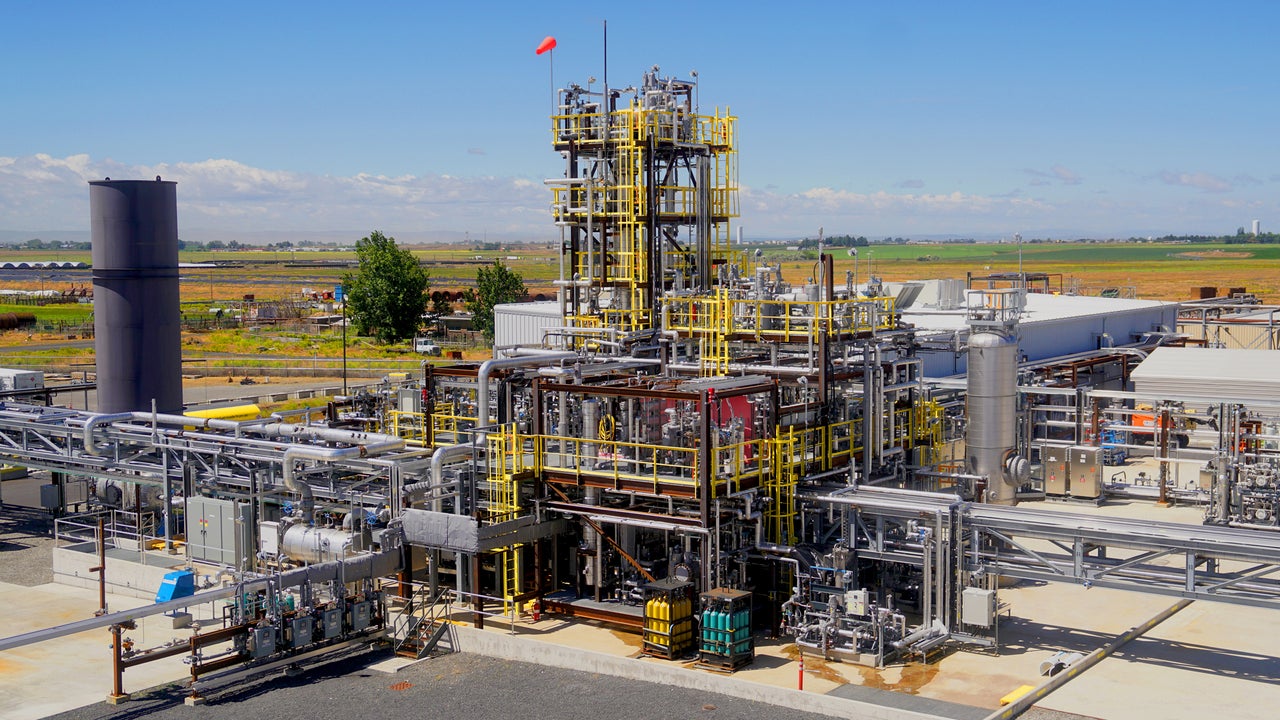
A New Era for Aviation: Jet Fuel Made Entirely from CO2
For decades, the aviation industry has struggled to answer one of the hardest questions in the fight against climate change: how do you decarbonize an industry that literally runs on fossil fuel? Batteries are too heavy for commercial aircraft, hydrogen infrastructure barely exists, and offsets only go so far. Now, a startup called Twelve believes it has found a real, scalable answer — and it just opened the factory to prove it.
Located near farm fields in Washington State, AirPlant One is the world's first commercial-scale facility designed to take captured carbon dioxide and transform it directly into jet fuel. The plant officially opened in June 2025, and passenger flights are expected to begin using the resulting fuel within weeks of its launch. It is a milestone that many clean energy advocates have been waiting years to see.
Who Is Twelve and What Have They Built?
Twelve is a California-based startup that has spent more than a decade developing and refining its core technology: a process that converts CO2 into valuable, usable products. The company has explored a range of applications for this technology, from plastics to fuels, but sustainable aviation fuel — known in the industry as SAF — has always been one of its most consequential targets.
AirPlant One is the physical embodiment of that decade-long research effort. It is a full commercial production facility, not a pilot project or a demonstration plant. According to CEO and cofounder Nicolas Flanders, the process is exactly what the name suggests: "You have a CO2 molecule going in at one end of the plant, and it is getting transformed into on-spec jet fuel on the other side."
That clarity of purpose — input to output, carbon to fuel — is what makes the facility stand out in a landscape crowded with incremental climate solutions and aspirational timelines that rarely arrive on schedule.
How Does the CO2-to-Jet-Fuel Process Actually Work?
The science behind AirPlant One is sophisticated, but the core logic is elegant. The process begins with a large tank of captured CO2, sourced from pollution collected at a nearby ethanol production facility. Rather than allowing that carbon dioxide to escape into the atmosphere, it is redirected into Twelve's conversion system.
Inside the plant, the CO2 is fed into an electrochemical reactor that runs on renewable electricity. This reactor converts the CO2 into syngas — a mixture of carbon monoxide and hydrogen that has long served as a chemical building block in industrial processes. From syngas, the system produces synthetic crude oil. That synthetic crude is then refined using conventional downstream processes into a finished fuel product.
Twelve brands the end result as E-Jet sustainable aviation fuel. It meets standard jet fuel specifications, meaning it can be used in existing aircraft engines and existing fueling infrastructure without modification. This drop-in compatibility is critical — it means the fuel can enter the aviation supply chain immediately, without waiting for airlines or airports to upgrade their equipment.
Why Sustainable Aviation Fuel Matters So Much Right Now
Aviation accounts for roughly 2 to 3 percent of global CO2 emissions — a figure that sounds modest until you consider that it also represents one of the fastest-growing and hardest-to-abate segments of the global economy. Unlike passenger cars or electricity generation, aviation has very few near-term alternatives to liquid fuel. That reality has pushed governments, airlines, and researchers to place enormous hope in SAF as a bridging solution.
The challenge has always been supply. Currently, SAF makes up a tiny fraction — well under one percent — of global jet fuel consumption. Most existing SAF is produced from waste fats, oils, and agricultural residues, and there simply is not enough of those feedstocks to meet global demand even if every drop were captured and converted. New production pathways are urgently needed.
That is exactly where Twelve's approach becomes strategically important. By using CO2 as a feedstock instead of biological waste materials, the company sidesteps the feedstock scarcity problem entirely. CO2 is, unfortunately, abundant — and capturing it from industrial point sources like ethanol plants is a well-established practice.
The Role of Renewable Energy in Making This Work
One crucial detail in Twelve's process deserves particular attention: the electrochemical reactor runs on renewable electricity. This matters enormously for the fuel's overall carbon accounting. If the electricity powering the conversion came from fossil fuel sources, the lifecycle emissions of the resulting jet fuel would be far less impressive. But powered by wind, solar, or hydroelectric energy — all of which are abundant in the Pacific Northwest — the process can produce fuel with dramatically lower lifecycle carbon emissions than conventional jet fuel.
This renewable electricity dependency also means that the economics and emissions profile of E-Jet will improve over time as the grid continues to clean up, without requiring any changes to the plant itself.
What Comes Next for AirPlant One and Twelve?
The opening of AirPlant One is a beginning, not a finish line. The facility's current production capacity is modest relative to the scale of global aviation demand, but that is typical for first-of-kind commercial plants in any emerging technology sector. The purpose of AirPlant One is to prove that the process works reliably at scale, drive down unit costs through operational learning, and attract the investment needed to build larger, higher-capacity plants in the future.
For the aviation industry, the climate tech community, and anyone watching the slow, difficult work of decarbonizing the global economy, the opening of AirPlant One represents something genuinely worth paying attention to: a moment when a decade of laboratory research finally met the real world, and the real world got a little cleaner because of it.
- Location: Washington State, near agricultural land
- Feedstock: Captured CO2 from an ethanol production facility
- Energy source: Renewable electricity
- Output: E-Jet sustainable aviation fuel, fully drop-in compatible
- Company: Twelve, founded over a decade ago with a focus on CO2 conversion technology
- Status: Commercially operational as of June 2025, with passenger flight use expected imminently